
24. June 2024 – Arnold Kürsteiner & Veronica Speiser
Introduction
As of June 2024, BDUK has awarded 32 Project Gigabit contracts worth £1.4bn in Government funding. The contracts will aim to cover c.785k premises in hard-to-reach or commercially underserved areas in England. In April 2024, Point Topic received postcode data on 30 of the awarded contracts through a Department of Science, Information and Technology (DSIT) Freedom of Information request1.
According to BDUK, ‘Intervention areas have been broken down into three types of intervention areas which will deliver subsidised gigabit networks, consisting of regional, cross-regional and local supplier areas’2.
This report does not cover any cross-regional intervention lots. These lots are comprised of intervention areas of up to 500k premises which have fallen outside of the local or regional supplier bidding or have not had any viable interest put forward by a supplier. Due to the size and scale of these lots such contracts tend to be awarded to larger national players. On 16 May, DSIT allocated Openreach as preferred bidder for these areas. We have obtained 6 cross-regional areas postcode datasets from the FOI request; however, they are currently undergoing the live procurement stage or are due to commence later this year. This report also does not cover any regional and local lots which have not yet been awarded.
Using our own postcode availability data, Point Topic presents its findings on the regional spread of awarded BDUK support as well as the relationship between footprint availability of both Openreach and the awarded suppliers, within each regional and local lot, at the time of BDUK contract award date.
It is important to note that Project Gigabit interventions are planned and awarded at premises (UPRN) level, not at postcode level. Point Topic availability data is postcode-level and does not distinguish between premises/UPRNs. While some premises in a postcode are commercially viable, others may not be and require support. Should operators have a footprint in a postcode within an awarded Project Gigabit lot, this does not mean they have a footprint across the awarded premises. Thus, an operator having a footprint in an awarded postcode does not mean they offer services in the Project Gigabit-related premises.
Project Gigabit Lots
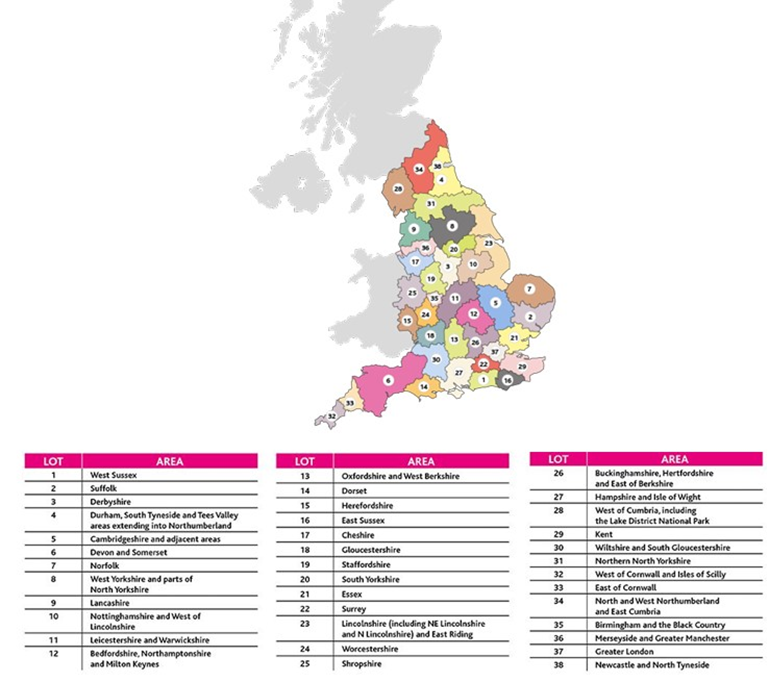
Above map shows Project Gigabit BDUK regional intervention areas (lots). BDUK has deemed local intervention areas as those that will cover up to 15k premises with regional areas covering up to 100k premises. For example, Lot 14 Dorset is a regional contract awarded to Wessex Internet and aims to cover c.21,500 premises, whereas Lot 14.01 North Dorset is a local contract within the larger region but only covers 7k premises.
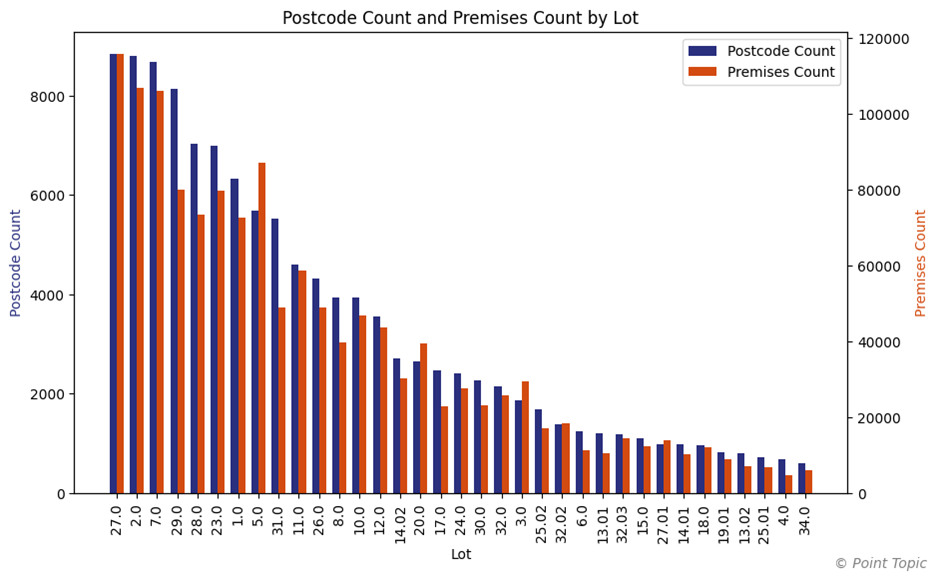
Postcode and premises count varies significantly by lot:
Where are the lots?
Project Gigabit lots have been awarded within England only, their purpose being “to enable hard-to-reach communities to access lightning-fast gigabit-capable broadband”3. We can break down the count of postcodes included in each lot by UK government region:
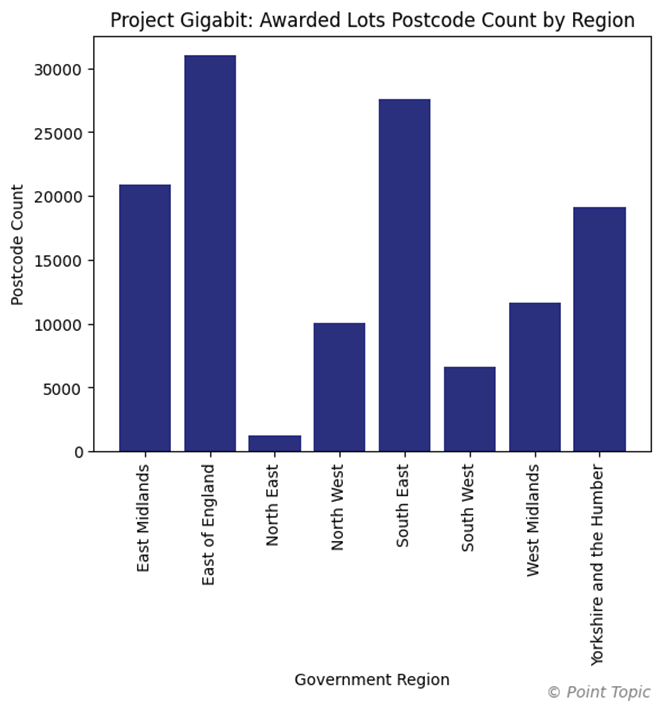
We so far see that the number of postcodes awarded support by Project Gigabit varies across different regions. However, not all lots have been awarded so far. Any lots for which we have no data from our FOI request, or for which we only have data for local but not the overall (regional) lot, are excluded from this section of the report:
Lot 9 (North West)
Lot 13 (West Midlands)
Lot 14 (South West)
Lot 16 (South East)
Lot 19 (West Midlands)
Lot 21 (East of England)
Lot 22 (South East)
Lot 25 (West Midlands)
Lot 33 (South West)
Lot 35 (West Midlands)
Lot 36 (North West)
Lot 37 (London)
Lot 38 (North East)
More lots will be awarded in the future. This will result in higher proportions of awarded postcodes in the below regions:
North West
West Midlands
South East
South West
East of England
North East
According to Point Topic, the May 2024 ratio of gigabit-capable postcodes per region is:
Government Region | Premises | Ratio Gigabit-Capable (FTTP/ DOCSIS 3.1) |
East Midlands | 2,384,332 | 0.81 |
East of England | 3,095,019 | 0.77 |
London | 4,087,864 | 0.88 |
North East | 1,351,230 | 0.82 |
North West | 3,682,938 | 0.84 |
Northern Ireland | 926,161 | 0.95 |
Scotland | 2,908,482 | 0.75 |
South East | 4,489,469 | 0.79 |
South West | 2,885,316 | 0.73 |
Wales | 1,573,631 | 0.72 |
West Midlands | 2,822,627 | 0.85 |
Yorkshire and The Humber | 2,711,745 | 0.85 |
When looking at both in combination, we see that the number of postcodes per region awarded BDUK support varies, with the North East having been awarded a lower number of postcodes relative to the South East, despite having very similar levels of gigabit-capable availability.
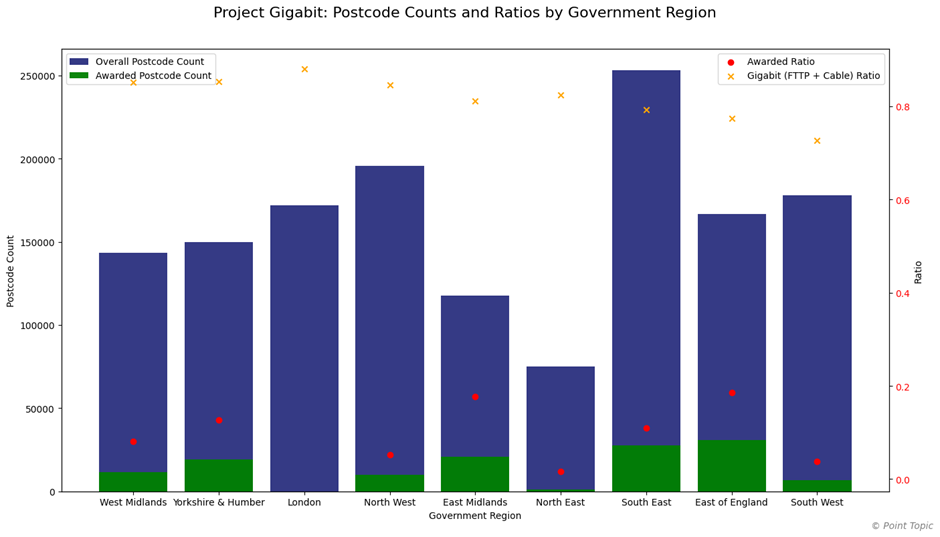
Once again, as a caveat, only some premises within each awarded postcode are going to receive subsidies as part of Project Gigabit, so while ‘Awarded Ratio’ can be as high as 0.2 in the graph above, the true number of households receiving subsidies is going to be a fraction of that.
Openreach Footprint at awarded regional and local lots
Using the data available for awarded lots, we determine the proportion of postcodes with existing Openreach gigabit-capable coverage at time of award of each lot. Should the contract award date be a range of dates, we pick the earliest date.
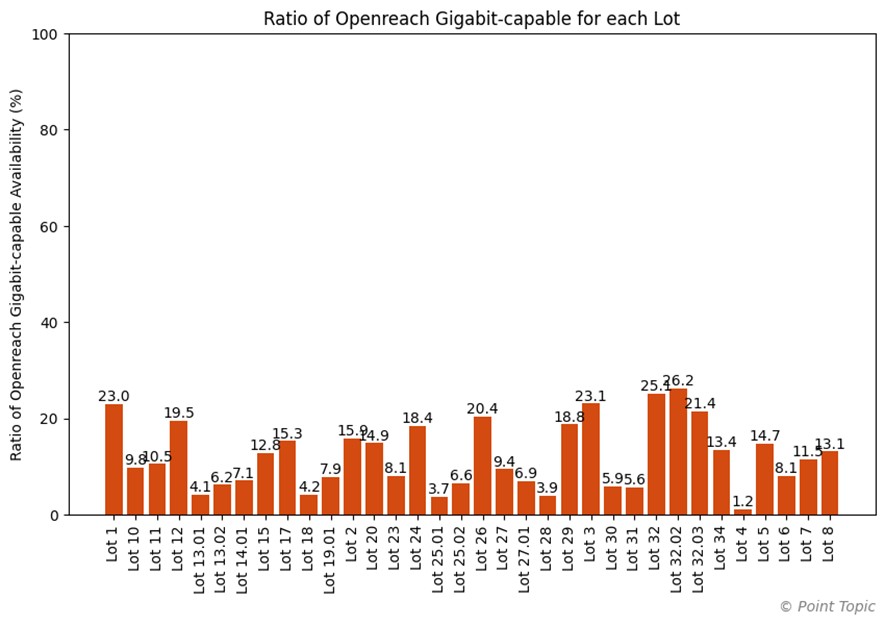
The proportion of gigabit-capable Openreach presence tends to be between 5% and 25% of postcodes in each awarded lot, with an average around 12.2%. Coverage is highest in Lot 32 (West Cornwall and Isles of Scilly) and Lot 32.02 (Central Cornwall), where Wildanet have been awarded the local Project Gigabit contracts but had little to no presence at the time.
As previously discussed, it is important to note that this does not imply that 5% to 25% of BDUK premises/UPRNs in awarded lots already had pre-existing coverage from Openreach at time of awarding – our analysis was conducted at postcode level and premises-level overlap is likely to be significantly lower.
More detail, including data on altnets and their availability in lots awarded to them at award date, is available to subscribers of UK Plus.
Conclusion
After comparing gigabit-capable coverage within awarded postcodes by the incumbent, BT’s Openreach, along with Altnets who have been awarded contracts by the BDUK, coverage varied significantly across government regions.
Looking at BDUK's awarded lots, on average Openreach’s full fibre (gigabit-capable) coverage within these postcodes reached around 12.2% overall; its coverage peaked in the mid-20% range in the South West i.e. Lot 32 West Cornwall and Isles of Scilly and Lot 32.02 Central Cornwall, where Wildanet have been awarded the local Project Gigabit contracts but had little to no presence at the time.
There is a large regional variation in the ratio of awarded postcodes as a proportion of all postcodes. For example, the ratio was more than twice in the South East compared to the North East.
One should be aware though, as caveats apply – our study was conducted at postcode-level while BDUK lots are awarded at premises/UPRN-level – postcode-level overlap between operator coverage and BDUK postcodes does not necessarily translate to premises-level overbuild.
A further update to this report will be available over the next few months as further contracts are awarded. Along with publishing an update to our appeal to the FOI DSIT team for further information regarding the discrepancies in the number of awarded postcodes supplied to us in the original request compared to what was released in BDUK’s September 2023 National Open Market Review Outcome in April 2024.
Subscribers to our UK Plus service have access to the full report.
Cite this: Point Topic, “BDUK Project Gigabit Postcode Build Analysis – June 2024”, 3 July 2024, https://www.point-topic.com/analysis/bduk-2024/