
The data files for the 2024 general election were published in the last few weeks. Listing the constituencies, candidates, vote share, change and other bits you can download them yourself here
- https://commonslibrary.parliament.uk/research-briefings/cbp-10009/
and if you want to relate it all to postcode level data then there’s a lookup here
Some outcomes
We will build up to a relationship (if any) between broadband and voting but first some guidance for potential candidates in 2029.
There were 28.8M votes cast across 4,515 candidates in 650 constituencies.
There were 99 parties with candidates across those constituencies, we’ve put a table with all the votes by party at the bottom of this post. Ultimately 15* parties were elected.*Bundling all ‘independents’ together.
The highest vote share was 74.3% (Lindsey Hoyle, Speaker of the House) and the lowest was 0.049% from an Independent candidate standing in Holborn & St Pancras.
The best performing Conservative in terms of vote share was Bob Blackman in Harrow East with 53.3%. Rishi Sunak was next for the Conservatives and scored 47.5%. He was 154th in the vote share ranks.
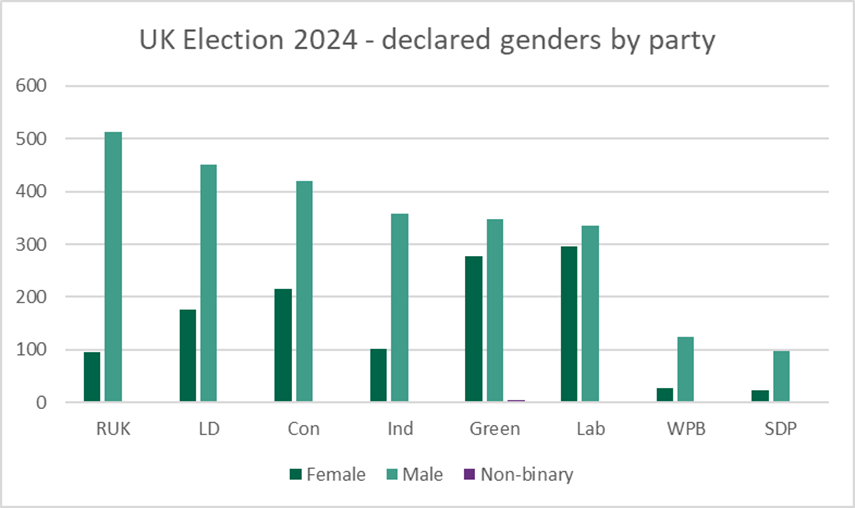
There were more than 100 candidates with the first name ‘David’. Just over 900 candidates had a ‘unique’ first name in the set of all those standing, over 4,500 people.
Broadband: votes, parties and constituencies
Our analysis focuses on fixed broadband. Which means a wire (copper, co-axial or glass) from a telephone exchange to a premises.
The constituency with the fastest downstream broadband available is Ashton-under-Lyne where ISPs like YouFibre drive the average available bandwidth over 6Gbps across all postcodes in the area. Angela Rayner’s constituents can watch dozens of HD streams simultaneously if they wish.
The slowest constituency is Na h-Eileanan an Iar in Scotland where the average bandwidth available is only 75Mbps, less than 2% of the speeds achieved in Ashton.
Labour constituencies have faster downstream bandwidths available, on average, than any other party apart from the Greens, the SDLP and the Speaker but only just ahead of Reform UK.
Party | Constituency count | Average of max bandwidth (Mbps) |
Speaker | 1 | 2,497 |
SDLP | 2 | 1,828 |
Green | 4 | 1,811 |
Lab | 411 | 1,198 |
RUK | 5 | 1,189 |
SF | 7 | 1,027 |
Ind | 6 | 993 |
APNI | 1 | 981 |
DUP | 5 | 954 |
TUV | 1 | 909 |
LD | 72 | 898 |
UUP | 1 | 894 |
Con | 121 | 850 |
SNP | 9 | 547 |
PC | 4 | 435 |
Grand Total | 650 | 1,087 |
There does appear to be a relationship between country and bandwidth highlighted at the constituency level. The SNP and Plaid Cymru are both well below the averages in other areas. This aligns with the national picture where much of the rural population has access to lower speeds particularly in devolved nations.
The relatively small sample size outside the top three UK parties makes any assumptions or extrapolations unwise. If we look at the larger parties we stand a better chance of seeing what, if any, relationships there are between broadband speeds and vote share.
This is the basis of our (null) hypothesis. Change in vote share for Labour has no connection with change in bandwidth.
This diagram plots the change in bandwidth since the last election versus the change in Labour vote share.
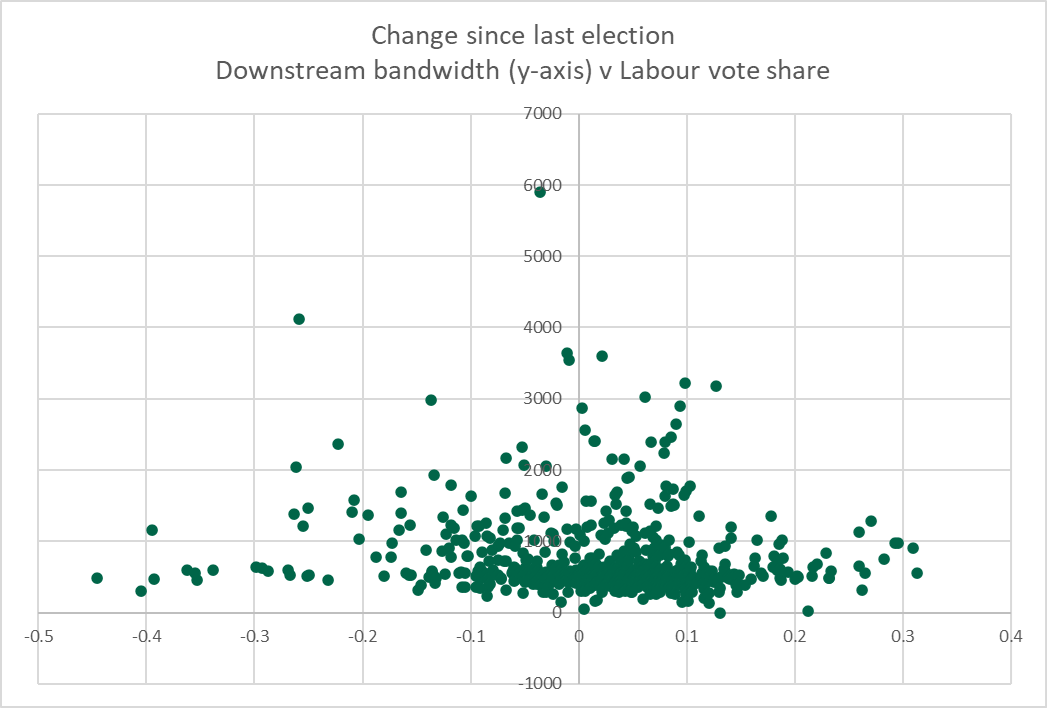
You could with a charitable eye say there is some relationship and in pairwise tests there does appear to be some significance for faster speeds correlated with a higher swing to Labour.
However much like the relationships we saw with Brexit, where higher bandwidth broadband appeared to have a relationship with voting Remain, these effects are covariates with other demographic factors.
Faster and higher take-up of broadband is associated with younger, more affluent, often urban and educated cohorts. If you include those factors, or proxies for them, and review the relative impacts, broadband availability and speed has little impact in the UK today on how we choose to vote.
That said there is certainly some relationship and the table of Results and average bandwidth again suggests a link between Labour vote, and in particular Labour vote churned from Conservatives as opposed to Conservative holds.
Result | Average of max bandwidth Mbps | Count of Result |
Lab hold | 1,353 | 193 |
Lab gain from Con | 1,078 | 182 |
Con hold | 848 | 120 |
LD gain from Con | 907 | 60 |
Lab gain from SNP | 972 | 36 |
SNP hold | 585 | 8 |
LD hold | 973 | 8 |
SF hold | 1,027 | 7 |
DUP hold | 954 | 5 |
RUK gain from Con | 1,189 | 5 |
Ind gain from Lab | 990 | 5 |
LD gain from SNP | 605 | 4 |
PC hold | 469 | 2 |
SDLP hold | 1,828 | 2 |
Green gain from Con | 757 | 2 |
PC gain from Con | 400 | 2 |
TUV gain from DUP | 909 | 1 |
Green hold | 966 | 1 |
APNI gain from DUP | 981 | 1 |
Green gain from Lab | 4,762 | 1 |
Spk hold | 2,497 | 1 |
Con gain from Lab | 1,079 | 1 |
UUP gain from DUP | 894 | 1 |
Ind gain from APNI | 1,006 | 1 |
SNP gain from Con | 244 | 1 |
Certainly being online has an effect on our opinions and actions. The internet and the algorithms that govern much of what we see on our favourite pages and applications, and most people visit only 4 or 5 sites on a regular basis, has had an impact on all of us.
Past a certain point though our own ‘bandwidth’ is maxed out, at least as far as any further impact on voting. Once you can easily access multiple channels/sites/inputs at one time, which almost all the UK can, the impact has been made and the marginal effect of more speed is limited.
Cite this: Point Topic, “Broadband speeds and the UK election”, 9 September 2024, https://www.point-topic.com/analysis/broadband-speeds-uk-election/