
Part II of UK Plus’ Ultrafast and Superfast Broadband Reports – Policy, Regulatory and Public Sector Updates October 2021 – October 2022
In Summary
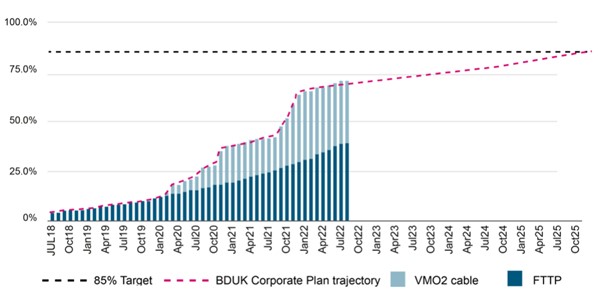
Since our last report published in October 2021, the UK’s telecoms sector has seen significant progress in terms of nationwide gigabit-capable fixed broadband coverage. According to the Department for Digital, Culture, Media & Sport’s (DCMS) latest Project Gigabit update report, published on 30 August 2022, nationwide gigabit-bit capable broadband coverage has increased from 42% to nearly 70% coverage year-on-year at the close of August.[1] For the same period, full fibre (FTTP) network coverage increased from 26% to just over 40%. However, this coverage is certainly not uniform throughout UK, especially in terms of rural versus urban network footprints along with full fibre access in the devolved nations, such as Scotland and Wales, where rural rollouts have proved more difficult.
Commercial rollout of gigabit capable broadband is expected to cover 80% of the UK by 2025, with BDUK focusing on subsidising the final 20%, predominately in rural or hard to reach areas. Building Digital UK (BDUK) announced on 6 January 2022 its ‘soft launch’ of a new Project Gigabit National Rolling Open Market Review (NR-OMR) process to confirm where gigabit-capable broadband infrastructure currently exists or is planned to be built in the UK over the next 3 years. The reviews are scheduled to take place every year in January, May and September with the first NR-OMR being open to specific suppliers only. Subsequent reviews have been opened up to further suppliers with the eventual aim of including all suppliers.
Several new legislative initiatives have been introduced over the past year to propel the rollout of a nationwide gigabit-capable digital infrastructure, boost the UK economy and ensure the country remains technologically competitive and forward-thinking. Key regulations include the Levelling Up the United Kingdom White Paper, the newly implemented Telecoms Security Act, along with the barrier busting Product Security and Telecommunications Infrastructure Bill.
Telecommunications regulator, Ofcom, has also introduced key regulations to protect the consumer, promote competition within a highly saturated broadband supplier market, and support the government’s legislations. Ofcom’s key telecoms sector publications throughout year included the Online Nation Report 2022 (covering up to September 2021) Communications Market Report 2022 (up to December 2021) and the Media Nations 2022 Report covering Q2 2022. On 15 December 2021, Ofcom’s Plan of Work 2022/23 was published for consultation, with the regulator publishing its responses to stakeholders in March 2022. Further consultations regarding the future of radio spectrum management include the first ever, Spectrum Roadmap: Delivering Ofcom’s Spectrum Management Strategy and the Future Approach to Mobile Markets which outline key objectives and strategies for the wireless sector up to and beyond 2030.
1. Government Regulatory and Legislative Initiatives in Support of Nationwide Gigabit-capable Coverage by 2030
The section below provides further information about the progress of Project Gigabit overseen by the Department for Digital, Culture, Media & Sport (DCMS) through the Executive Agency, Building Digital UK (BDUK). Project Gigabit progress reports along with recommendations for the acceleration of the programme are also covered in the section, as well as other key government legislative reforms and proposals to support the telecoms sector.
1.1 Public Accounts Committee Gigabit Report Critical of Project Gigabit’s Slow Rural Deployments
The Public Accounts Committee (PAC) released their Delivering Gigabit-capable broadband report on 19 January 2022. Its findings were less than positive for the DCMS as it found that “the Department has made little tangible progress in delivering internet connectivity beyond that achieved by the private sector.”
The Committee put emphasis on the lack of transparency in reporting and understanding of the exact level of gigabit-capable network coverage beyond that of larger suppliers commercial achievements. For example, “gigabit broadband leapt from 40% to 57% between May and October 2021. However, while recognising that this is largely due to Virgin Media O2 upgrading its cable network, the Department is unable to fully explain why this has occurred.”[2]
Furthermore, it was concerned that through the DCMS’ continued focus on commercial network expansion filling the gap in nationwide coverage, it was not going far enough in addressing the potential digital divide between the commercially attractive and very hard to reach areas. DCMS’ lack of prioritisation in these areas could mean that nearly 134k premises would be left without gigabit-capable coverage by 2030.
Key recommendations put forward included:
To produce more accurate reporting metrics DCMS should work in conjunction with the National Audit Office.
By March 2022, DCMS should provide the government with transparent progress updates in terms of coverage by larger suppliers and AltNets, along with Gigabit Voucher scheme updates.
Provide detailed baseline figures on how it will achieve the 85% coverage target and progress reports against these baseline figures.
Demonstrate clear proactivity in the removal of legislative barriers to deployment, such as wayleaves, street works applications, etc.
Moving away from FTTP fixed line only solutions to mixed technologies solution (fixed wireless or satellite) for hard to reach locations.[3]
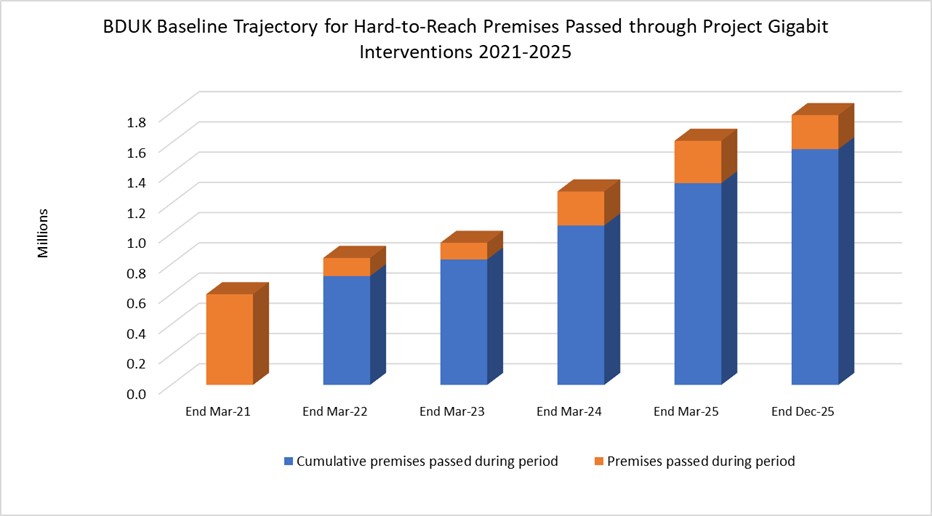
DCMS accepted the recommendations and on 29 April BDUK published its Corporate Plan 2022-23 – its first as an Executive Agency. BDUK stated in the plan that one key objective would be to provide coverage to at least 5% of hard to reach premises by 2025 (a minimum of 1.56m premises). In reaction to the PAC’s recommendation BDUK outlined its baseline trajectory to meet the 5% target which is outlined in Figure 1 below.
1.2 DCMS Project Gigabit Delivery Plan – 2022 Updates
Since the introduction of the government’s £5bn Project Gigabit subsidy programme to bring gigabit-capable broadband to underserved areas of the UK, DCMS has published quarterly progress updates.
Along with progress made to date, the reports contain timeframes for the procurements, rollouts, Gigabit Voucher scheme uptake, public sector GigaHubs expansions and progression in the devolved nations of similar schemes. The summer 2022 update, published in August was the latest progress report. Key quarterly programme updates from throughout the year have been summarised below.
Delivery Plan Winter Update – 9 February 2022
Sixteen local and devolved authorities had live schemes worth £10.5m to top-up existing voucher projects. First local supplier procurements launched in Dorset, North Northumberland and Teesdale.
Launched new Regional Supplier procurements in Cambridgeshire and the North East of England, as well as Local Supplier procurements in rural Dorset, North Northumberland and Teesdale.
Market consultation carried out about the details of upcoming procurements in Cornwall, Norfolk, Suffolk, Hampshire and Shropshire.
Announced BDUK to become an Executive Agency of DCMS from April 2022, with more operational autonomy to focus on Project Gigabit as well as the £1bn Shared Rural Network.
Over 1,500 project applications submitted by suppliers for the Gigabit Voucher Scheme, with Buckinghamshire becoming the latest top-up voucher partner to go live with a commitment of £1m, along with Kent investing a further £1.5m into their top-up scheme to bring ultrafast broadband to hard to reach areas.[4]
BDUK provided further clarification on which of the initial procurements are rural: 85% of the ‘Initial Scope’ of Regional Suppliers and are being prioritised first; 82% of the ‘Deferred Scope’ but are awaiting commercial funding and roll-out before confirming intervention; 95% of the Local Supplier procurements.[5]
Delivery Plan Spring Update – 30 May 2022
BDUK reached 100k milestone of Gigabit Vouchers issued worth £185m with 65k claimed.
Local Full Fibre Networks (LFFN) programme concluded on 31 March 2022, 1 Gbps connectivity to more than 5,000 public buildings and 500 public assets, with a government investment of £164m.
Seven hundred public GigaHubs were upgraded during the quarter, including schools, GP surgeries and libraries.
Regional procurements launched in Norfolk and Suffolk, two local procurements in Cornwall with aim of covering 190k premises.
Completed over 20 market engagements across the UK.
Sixty-six per cent of homes and 40% of businesses had access to 1 Gbps broadband.
Rural and urban divide highlighted as a concern due to VMO2’s (mostly urban) network upgrade where it pushed gigabit-capable coverage up to 68% of the country, 70% of urban areas have coverage as compared to only 30% of rural areas.
Delivery Plan Summer Update – 30 August 2022
UK gigabit-capable network coverage as of 17 August 2022 reached 70% up from 42.4% year-on-year (Figure 2).
First procurement contract signed in North Devon with supplier Wessex Internet, to cover 7k premises; further contracts due to be awarded in Teesdale and Northumberland in coming months.
Local and regional procurements launched in Hampshire and Shropshire for 118k premises
Total value of Project Gigabit procurements to date >£690 million; 498k premises passed with gigabit-capable broadband.
£82 million investment announced with the Department for Education connect 3k schools to gigabit-capable broadband.
To date over 106k vouchers worth more than £214 million have been issued through the Gigabit Broadband Voucher Scheme, with 73k having been implemented.
Published new research on the use of Gigabit Broadband Voucher scheme by SMEs, found over 80% reported an increase in productivity due to connection upgrades along with 70% reporting more efficient and stable business activity during the Covid pandemic.
Published BDUK’s 2021 to 2022 Performance Report.
1.3 Levelling up the UK White Paper – Confirming the Nationwide Gigabit Coverage Goal by 2030
On 2 February, the UK government published its Levelling Up the United Kingdom White Paper which outlined its 10-year plans to tackle geographical disparity and taking pressure off of London and the South East, “by improving economic dynamism and innovation to drive growth across the whole country, unleashing the power of the private sector to unlock jobs and opportunity for all.” To meet its levelling up and equalisation strategies, the UK government set out clear and ambitious medium‑term missions to provide consistency and clarity over levelling up policy objectives. The 12 missions will serve as an anchor for policy across government, as well as catalysing innovation and action by the private and civil society sectors. These missions are ambitions that the UK government has for all parts of the UK.
Until the release of the paper, the Conservative government had been openly vague about its timelines for achieving nationwide gigabit-capable broadband coverage as they scaled back their ambitions to reach 85% coverage by 2025, with the aim of getting as close as possible to 100% without any end date. However, Mission Four confirmed that by 2030, the UK will have nationwide gigabit-capable broadband and 4G coverage, with 5G coverage for the majority of the population.
The government did stipulate that nationwide coverage for gigabit capable services will cover “at least” 99% of premises, with 4G services likely to cover 95% of the landmass by the end of 2025, with 5G ambitions to reviewed on a rolling basis to ensure targets are fit for purpose. It is worth noting that 5G coverage ambitions have already been downgraded from the Conservative’s 2017 manifesto where it outlined plans to “have the majority of the population covered by a 5G signal by 2027.” [6]
Key points of Mission Four include:
Aims to address spatial disparities in digital infrastructure provision between densely versus sparsely populated areas.
Seeking alternative solutions to reach the final 0.3% - less than 100k – very hard to reach premises as the economic incentives for the private sector to provide services to these communities are less clear cut.
Metrics for this mission will be tracked at lower tier local authority level using Office of Communications (Ofcom) and Thinkbroadband data.
DCMS’ 8 February publication Improving Broadband for Very Hard to Reach Premises: Government Response underscored the need for a mixed technological approach to reaching the c.100k remote premises. The report intimated that given the cost-prohibitive solutions to supplying FTTP networks to these remote premises, it is likely that the government will encourage suppliers to use new fixed wireless solutions, LEO satellites (e.g. Starlink, OneWeb) and hybrid platforms to help push faster broadband into the hardest to reach areas.
On 13 June, DCMS released its UK Digital Strategy which outlined a new single vision to grow the digital economy whist addressing tech sector skills, investment, and infrastructure. The paper reiterated the government’s commitment to ~99% nationwide gigabit coverage by 2030, along with majority of areas having 5G coverage over the next five years.
1.4 Ultrafast Connectivity and Building Regulations 2010 Reforms for New Developments – Do They Go Far Enough?
On 22 September, the Government issued its consultation outcome statement on last year’s technical consultation. Despite the new legal frameworks being introduced in the statement when reading the fine print the reforms may not go far enough for some, especially those looking at new build homes in rural areas. The rules coming into effect for developers – at this point those only in England as new regulations are looking to be introduced in the devolved nations in the future – state the following:
All new build homes are installed with the gigabit-ready physical infrastructure necessary for gigabit-capable connections.
A gigabit-capable connection is installed in a new build home subject to a £2,000 cost cap per dwelling, or
Where a gigabit-capable connection is not being installed, the next fastest broadband connection is installed without exceeding the £2,000 cost cap.[7]
However, the rub comes when reviewing the last point as where gigabit-capable technically either through full fibre, coaxial cable, or wireless technically cannot be installed without exceeding the cost cap, the next best technically can be introduced ensuring minimum downlink speeds of 30 Mbps. Where this isn’t possible, then technology meeting the Universal Service Obligation (USO) speeds of 10 Mbps can be introduced.
For those in hard to reach or rural areas where no physical ultrafast infrastructure is in place may getting left behind as providers have stated that the costs of deploying to these areas can be prohibitively expensive. However, several suppliers such as OFNL, Hyperoptic, VMO2, and Gigaclear have already been making it cheaper and more efficient for developers to deploy FTTP connectivity to their developments. Openreach have also been actively replacing legacy copper networks in newly built estates which has also contributed to an increase in the availability of ultrafast connections.
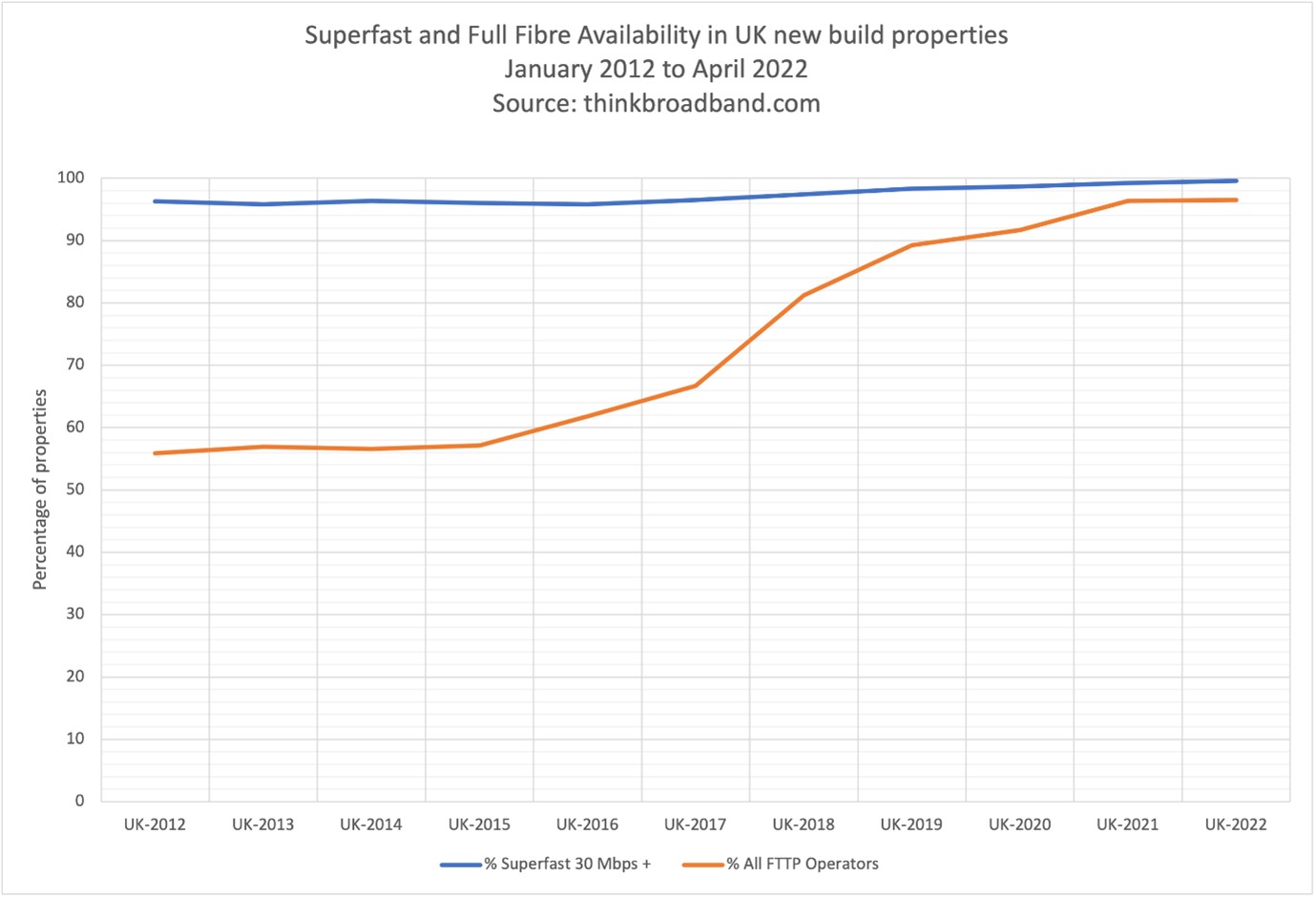
According to data published by Thinkbroadband in June 2022, 96% of new build properties have full fibre broadband up from 60% in 2017.[8]
1.5 Shared Rural Network – Progress Update
The Shared Rural Network (SRN) is a deal with EE, O2, Three and Vodafone investing in a network of new and existing phone masts, overseen by a jointly owned company called Digital Mobile Spectrum Limited (DMSL), they would all share.
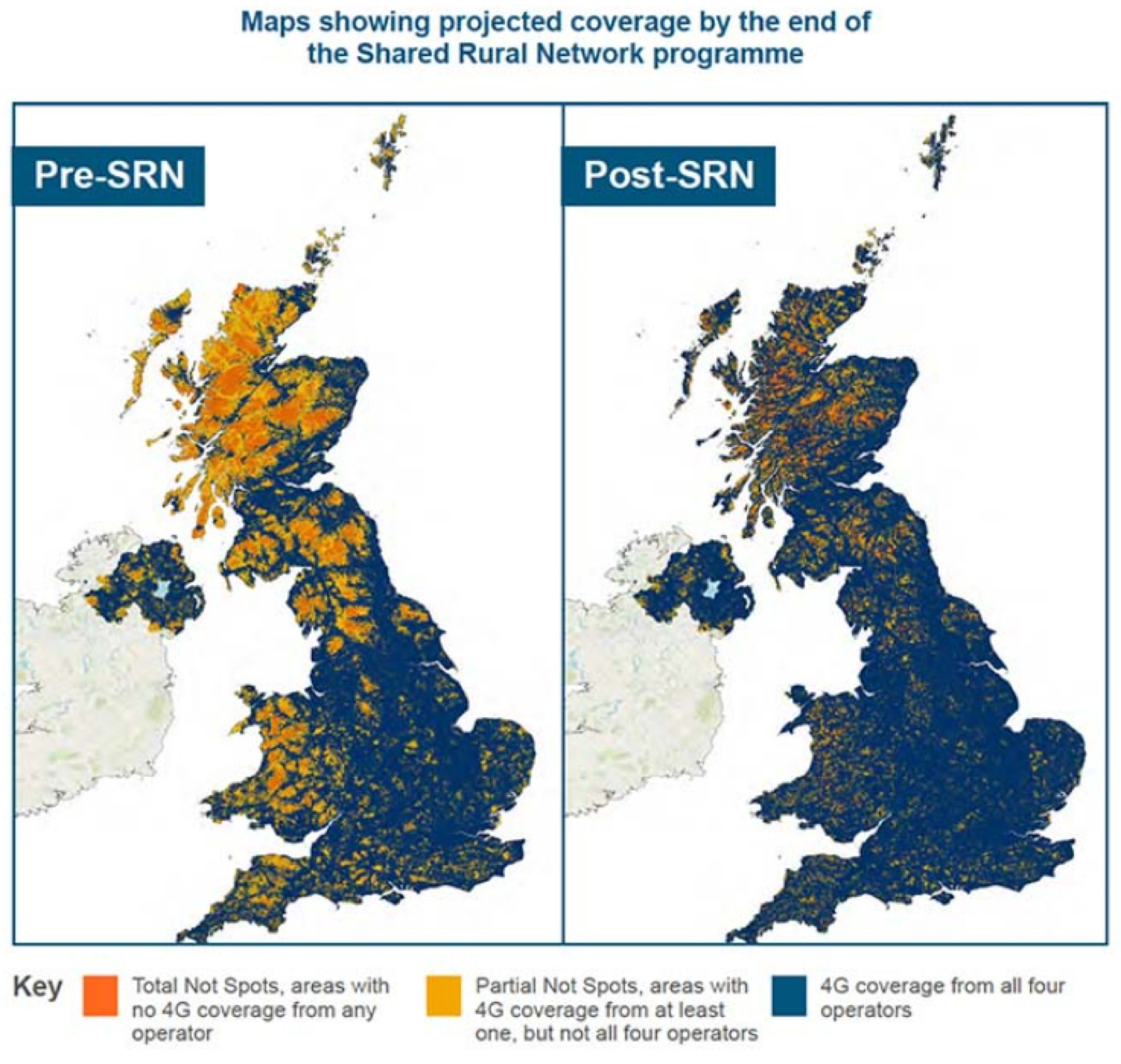
The aim is to provide coverage to 280k premises and 16,000 km of roads, with increases in coverage in some areas by more than a third, with the biggest coverage improvements in rural parts of Scotland, Northern Ireland and Wales. It aims to provide 4G coverage to 95% of the UK landmass by end of 2025 (Figure 4).
The BDUK’s 2021 to 2022 Performance Report summarised the project’s progress to date as:
Forty six new commercially funded Partial Not Spots masts were erected between April 2021 and March 2022 with BDUK currently supporting a further 21 applications with 3 approved and a total of 850 upgrades to existing Partial Not Spots masts being completed since March 2020.
DMSL finalised two Total Not Spots procurement contracts.[9]
2. Ofcom Announcements
2.1 Ofcom Considers Future of Mobile Markets, Spectrum Management and Demand for Data
Ofcom published its Future Approach to Mobile Markets comments paper on 9 February in order to obtain feedback on its regulatory approach over the next five to ten years. The paper sought input from stakeholders to outline how different wireless technologies, outside of those being offered by the main four Mobile Network Operators (MNOs), will need to be overseen in the future.
The paper stated, “We recognise there is considerable uncertainty about the way mobile markets will develop…[and] given the changes taking place, it is a good time for us to take stock, assess how well the market might work for people and businesses, and consider whether and how we might adapt our regulatory approach.”
The regulator clearly stated that their initial views were not to initiate any market intervention at this stage, but to monitor and engage with the market in order to:
Further support the consumer in making more informed choices regarding their service provider.
Gain further insight into the wider benefits to society through the expansion of higher quality network services.[10]
Ofcom also underscored its commitment to investment and transparency within the sector through:
Setting out explicit explanations of how investment was considered when making policy decisions.
Keeping in place fair consumer pricing rules whilst continuing to monitor operators adherence to the regulations.
Clarification of position on market consolidation through supplier mergers and acquisitions and reviewing the potential lessening of competition within the market after the merger.[11]
In addition to the market overview, Ofcom published its Discussion paper: Meeting future demand for mobile data on the same date. The demand for mobile data has risen on average in the past several years by 40%[12], with this expected to grow. However, the regulator is uncertain as the pace of growth after 2030 and was seeking input from stakeholders on how to best manage and allocate spectrum for the purposes of wireless services.
Ofcom stressed the need for wireless networks to evolve, innovate, and expand in order to meet future demands. It suggested that this could be done by:
Greater expansion of existing spectrum holdings and planned future spectrum for mobile e.g. in the millimetre wave (mmWave) bands.
Increase network efficiency through technology upgrades.
Deploying more small cell sites to leverage the larger bandwidths available on the mmWave bands, known as network densification.[13]
Stakeholder inputs were received until 8 April 2022 with Ofcom expecting to publish their recommendations at the end of the year.
2.2 Ofcom Publishes First Ever ‘Spectrum Roadmap’ to Strategize the Future of Wireless Communications
On 31 March Ofcom published is first ever Spectrum Roadmap: Delivering Ofcom’s Spectrum Management Strategy, to set out its current and future objectives for the management of the UK’s radio spectrum.
The document covers key technological and market trends that Ofcom is taking under review to ensure the future management of spectrum allocation for evolving wireless technologies. Figures 5 and 6 below are excerpts from Ofcom’s strategy paper which provide a summary of current and future areas of work in spectrum management.
Earlier in the month, Ofcom published an additional spectrum management consultation paper, Space Spectrum Management. The strategy aims to undertake a refresh of the 2017 Strategy as the sector has undergone rapid and extensive changes. One key focus area of the new strategy will be on the growing use and subsequent demand on spectrum of non-geostationary orbit (NGSO) satellites, such as those deployed by operators such as OneWeb and SpaceX.
Ofcom notes the importance of NGSOs in providing broadband connectivity for remote locations, along with supplying backhaul for mobile base stations. Although Ofcom does note that they currently estimate satellite broadband users in the UK to be in the “low tens of thousands” and that fixed fibre coverage will cover nearly the whole of the UK by 2030 it does serve further purposes. “Even in the event uptake of direct-to-consumer satellite services in the UK remains relatively low, satellite could provide a means to improve the resilience of terrestrial networks in the event of natural disasters such as storms or floods.”[14]
As with the above consultations Ofcom is expected to issue its findings by the end of the year.
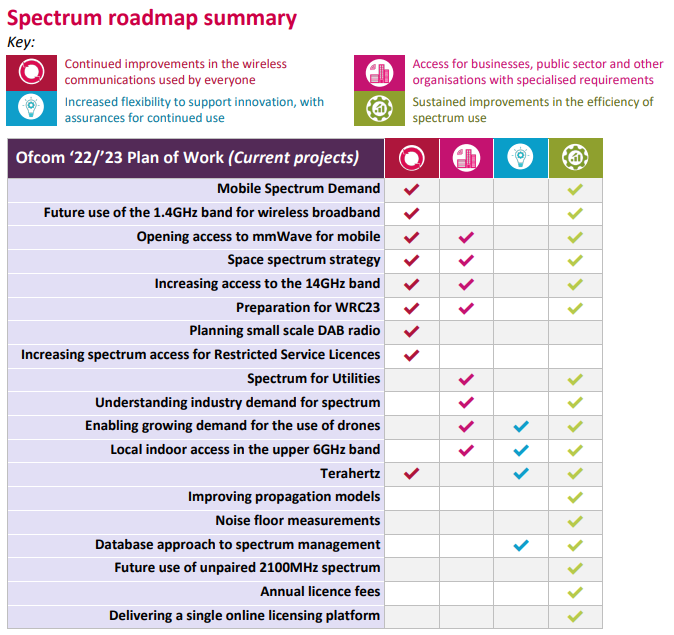
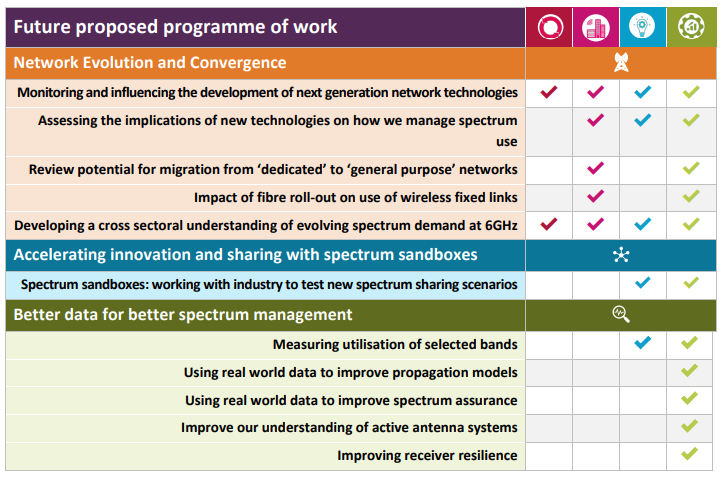
As the Spectrum Roadmap was published as a discussion paper, Ofcom invited feedback from stakeholders on their future work areas, including views on which are the highest priority, along with areas that may have not been included but may be of importance in the future. Ofcom also requested feedback on whether there are additional spectrum bands that were not covered in their reviews, but which stakeholders consider to be of importance over the next 5 years.
Feedback was being received until 20 May 2022, with further information to be provided later on in the year.
2.3 Key Quarterly Telecoms Sector Data Analyses and Communication Market Report 2022- Ofcom
Ofcom produces several key telecoms sector data analyses throughout the year, which includes subscribers, data revenues, and market share updates. Since our last report, the following reports have been published as below:
Q3 2021 Telecommunications Market Data Update – 27 January 2022
Q4 2021 Telecommunications Market Data Update – 28 April 2022
Q1 2022 Telecommunications Market Data Update – 28 July 2022
On 18 July Ofcom released its Communications Market Report 2022 which provides an overview of the telecoms sector as per the market data updates listed above. It also includes statistics on consumer research and technology tracker and costumer satisfaction data for the year ending 2021.
Key fixed line broadband findings within Ofcom’s Communication Market Report 2022, included:
The UK telecoms sector generated £31.1bn in revenue in 2021, a 4% decline year-on-year.
There were 27.7 million UK fixed broadband connections at the end of 2021, a 1% increase year-on-year.
Two-thirds (67%) of broadband connections were provided using fibre technologies at the end of 2021; 60% being FTTC, with full fibre accounting for 7% of all connections, a 50% increase year-on-year.[15]
2.4 Ofcom’s Plan of Work 2022/23
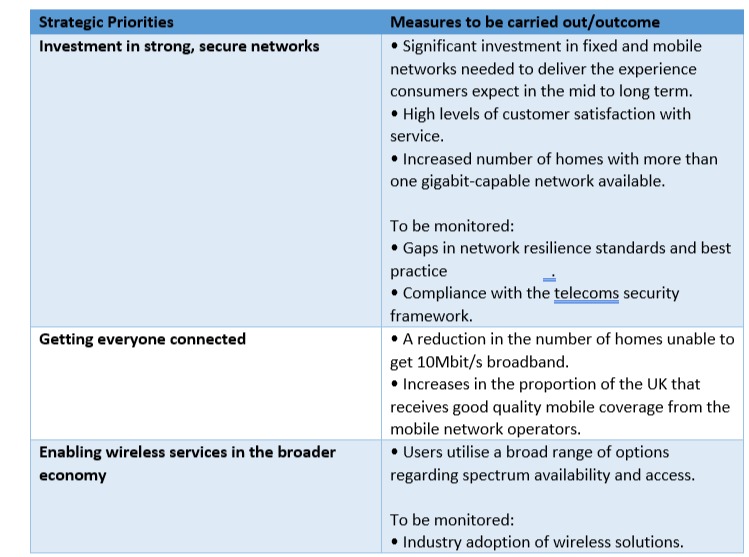
Ofcom’s Plan of Work for 2022/23 was published on 25 March 2022 and listed as its top priority the continued investment in resilient, high-quality, and reliable broadband and mobile networks which underpin how society lives, works, shops and uses public services in the UK.
Additionally, Ofcom will focus on closing the gap in broadband connectivity, especially in socio-economic households where 11% of those were likely to have access to the Internet. [16]
A few of the key strategic points and outcomes can be found in Figure 7. For a complete list of Ofcom’s projects for the financial year see page 43 of Ofcom’s Plan of Work 2022/23 report.
3. Scotland’s R100 Project Updates
3.1 Audit Scotland March 2022 Programme Update
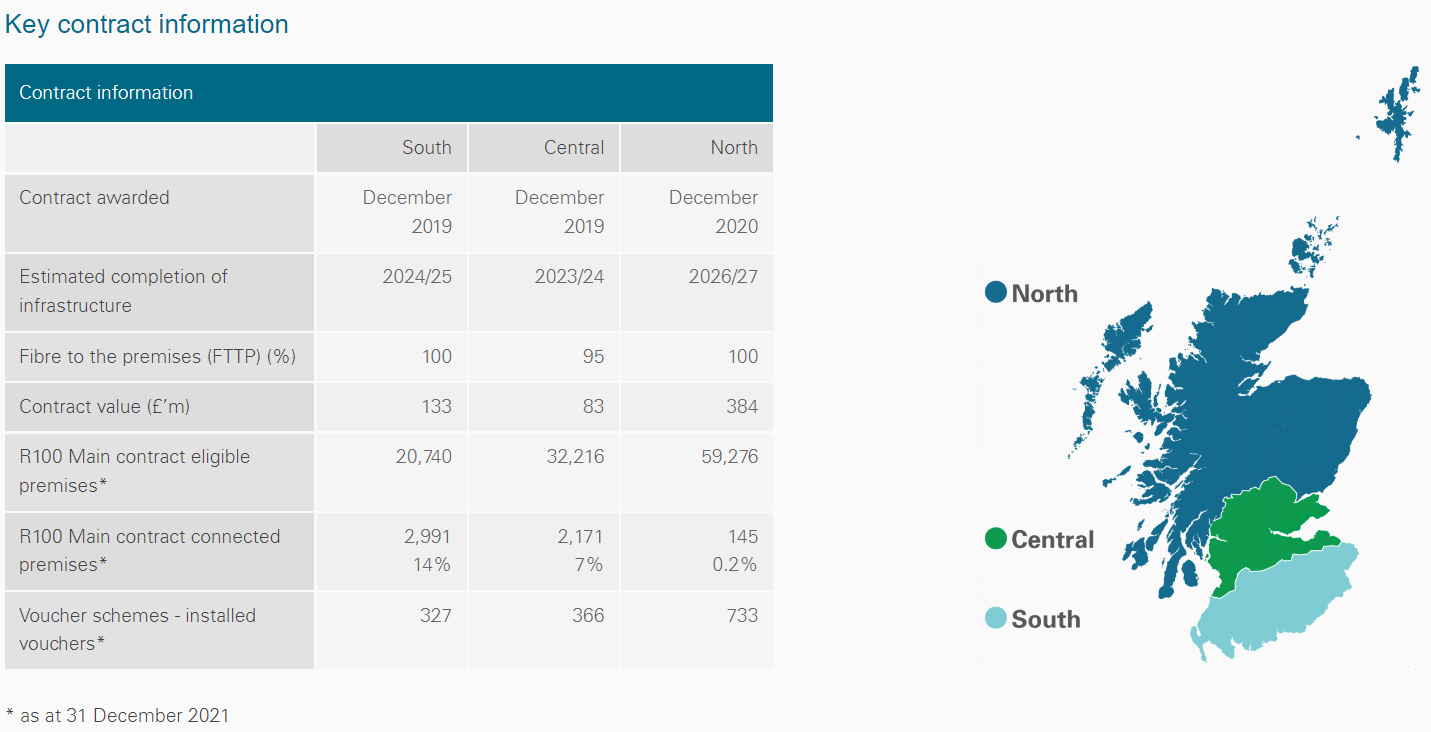
The R100 project was set up to help upgrade around 180k premises that were not part of the £442 million Digital Scotland project with Openreach. Originally the aim was to complete as many premises as possible by 2021 but rollout will now continue until 2023.
Three Lots were issued and in October 2019 it was announced the BT had won contracts for both Lot 2 (Central Scotland) and Lot 3 (South Scotland). The award of Lot 1 (North Scotland) took longer with several suppliers involved in the bidding, namely BT, Axione UK and Gigaclear, plus additional requirements attached. BT was again the preferred bidder. Gigaclear had lodged a legal challenge against the Lot 1 award, however BT Openreach were eventually awarded the Lot 1 contract in December 2020. Some £83 million of investment will go toward Lot 2; £133 million will go toward Lot 3.
An update report published on 15 March by Audit Scotland, provided an overall programme progress report including contract procurements and expected completion dates for each contract (Figure 8). At time of publication, around 112k premises had been connected through R100 contracts at the close of Q4 2021 with around 107k yet to be connected – the majority of those are in the northern most hard to reach areas.
3.2 Northern Ireland’s Project Stratum Project Updates
Northern Ireland remains one of the best connected nations within the UK with 86% gigabit-capable coverage. Commercial deployments throughout the province have come from mainly Openreach and VMO2.
The ministerial statement provided an overview of the progress to March 2022 with the key achievements outlined below:
Superfast access in rural areas increased to 70% from 67% year-on-year, due mainly to the implementation phase of Project Stratum.
Fibrus completed infrastructure deployment work to over 22k premises with all scheduled builds in 7 areas for the quarter on track to be delivered within the allocated timeframes.
More than 10k fibre poles have been planted, and 2,000 kilometres of fibre cable installed.
A further 8,500 premises have been added to the project, including 2,500 in hard to reach areas. Further funding of £22.3m from DCMS and an additional £4.25m each from DAERA and DfE have been secured to extend the project.
Fibrus aims to complete their Project Stratum deployments by March 2025.
3.3 Superfast Cymru Programme Updates
On 8 July, the Welsh Government provided a digital connectivity update which covered three main areas:
Barrier busting taskforce covering five key areas: planning, regulation, public assets, street works and communications, have undertaken reviews of each area with recommendations to be published in late 2022.
Government-sponsored Openreach full fibre deployment contracts have passed around 35k premises over the past three years with many in hard-to-reach areas of the country; the overall target will be just over 37k premises passed by March 2023.
The review of the Access Broadband Cymru grant process was completed with the online application system due to be implemented in the near future.[17]
If you are a subscriber to UK Plus, sign-in here for the complete report including the complete list of Project Gigabit Rural Intervention Projects and Procurements Pipeline
Please get in touch if you would like to find out more about UK Plus or these particular publications.
[1] DCMS, Policy Paper: Project Gigabit Delivery Plan - summer update 2022, 30 August 2022. [2]House of Commons Public Accounts Committee, Delivering gigabit-capable broadband report, 19 January 2022, summary. [3]House of Commons Public Accounts Committee, Delivering gigabit-capable broadband report, 19 January 2022, pages 4-8. [4]DCMS, Project Gigabit Delivery Plan – winter update, 9 February 2022, summary. [5]DCMS, Project Gigabit Delivery Plan – winter update, 9 February 2022. [6]DCMS, Policy Paper: UK Digital Strategy, World-class and secure digital infrastructure section, 13 June 2022. [7]DCMS, Consultation Outcome: New-build developments: delivering gigabit-capable connections, 22 September 2022. [8]Thinkbroadband, 96% of new properties in 2022 have full fibre available, 15 June 2022. [9]Corporate Report: BDUK’s 2021 to 2022 Performance Report, Shared Rural Network programme: Improving 4G mobile internet connectivity section, 29 July 2022. [10]Ofcom, Discussion paper: Ofcom’s future approach to mobile markets, 9 February 2022, p. 3. [11]Ibid, p. 4. [12]Ofcom, Discussion paper: Meeting future demand for mobile data, 9 February 2022, p. 4. [13]Ibid. [14]Ofcom, Consultation: Space Spectrum Strategy, 15 March 2022, p. 17. [15]Ofcom, Communications Market Report 2022, 18 July 2022, p. 3. [16]Ofcom, Plan of Work 2022/23, 25 March 2022, p. 12. [17]Welsh Government, Written Statement: Update on Digital Connectivity in Wales, 8 July 2022.
Cite this: Point Topic, “Gigabit-capable UK: transformation through regulation and reform”, 12 October 2022, https://www.point-topic.com/analysis/gigabit-capable-uk-transformation-through-regulation-and-reform/