
Macquarie Asset Management has appointed Perella Weinberg Partners to explore a sale of Hull incumbent KCOM, according to HullLive. The move follows a 2024 strategic review and comes amid mounting competitive pressure, as full fibre expansion by MS3, Grain and Connexin (now CityFibre-owned) continues to erode KCOM’s market share.
In this brief analysis, we look at the competitive and regulatory implications of the acquisition.
In this brief analysis, we look at the competitive and regulatory implications of the acquisition.
KCOM maintains legacy copper and full fibre networks in Hull and East Yorkshire. It operates a vertically integrated model providing full fibre consumer and business services along with some commercial and regulated WLA services. Due to this highly concentrated regional presence, it has exceptional market penetration in Yorkshire, representing a £250 - £290m acquisition opportunity for national players seeking Northern England expansion.
Table 1. Key Metrics, end-2025. Source: Point Topic.
| Metric | Value |
|---|---|
| Household Premises Passed | 268,829 |
| Business Sites Passed | 20,381 |
| Postcodes Covered | 13,569 |
| Total Premises Passed | 289,210 |
| Residential Subscribers | c.134,000 |
| Business Subscribers | c.11,000 |
| Total Subscribers | c.145,000 |
Table 2. Geographic Concentration of Footprint. Source: Point Topic.
| Local Authority | Premises | % of KCOM Footprint |
|---|---|---|
| East Riding of Yorkshire | 131,973 | 45.63% |
| Kingston upon Hull | 131,403 | 45.44% |
| North Lincolnshire | 19,646 | 6.79% |
| North Yorkshire | 5,787 | 2.00% |
| West Lindsey | 345 | 0.12% |
KCOM has a concentrated footprint of 91% of premises in just 2 local authorities (Hull and East Riding), representing both strength through market dominance and a risk through Ofcom’s regulatory framework for the supplier that has limited growth potential. Worth noting is that KCOM completed its full fibre network rollout in 2019.
Table 3. Competition and Overbuild in the KCOM Territory. Source: Point Topic.
| Rank | Competitor | Overbuilt Premises | % of KCOM Footprint |
|---|---|---|---|
| 1 | BT | 99,708 | 34.48% |
| 2 | MS3 FTTP | 96,565 | 33.39% |
| 3 | TalkTalk | 95,345 | 32.97% |
| 4 | Sky | 95,170 | 32.91% |
| 5 | CityFibre Connexin FTTP | 75,697 | 26.17% |
| 6 | Quickline 5G | 24,574 | 8.50% |
| 7 | Grain Connect | 17,372 | 6.01% |
| 8 | Quickline Rural FTTP | 5,873 | 2.03% |
| 9 | CityFibre TalkTalk | 5,366 | 1.86% |
| 10 | CityFibre Sky | 5,366 | 1.86% |
MS3 Networks represents the primary Altnet competitor with 33.39% overbuild, followed by Connexin’s 26.17% overlap, demonstrating it is gaining traction in the area. Quickline’s standalone 5G and FTTP networks have a combined 10.5% overbuild with KCOM in rural areas. National ISPs such as TalkTalk and Sky each have around a 33% network overlap, with Virgin Media O2 having a negligible presence in the area and not coming in the top ten.
Regulatory and Market Implications
On 18 December 2025, Ofcom published its Consultation:Promoting competition and investment in fibre networks - Hull Area Review 2026-31, due to come into effect in November 2026.
Historically, KCOM have retained a near monopoly at both the wholesale and retail levels in the Hull area. Over the past two years, MS3, CityFibre, Grain and some of the large national ISPs have increased their presence in the area, meaning that customers now have more choice, with around 70-79% of premises in the area having at least one alternative network to KCOM present.[1]
The potential sale of KCOM in mid-2026 introduces a structural overlay to this transition. The sale process is likely to overlap with Ofcom’s final decisions on market definition, Significant Market Power (SMP) and remedies. Ofcom typically designs remedies against prevailing ownership and competitive conditions. A change of control during or shortly after the review period raises a more fundamental question:
Are the proposed remedies robust to a change of ownership?
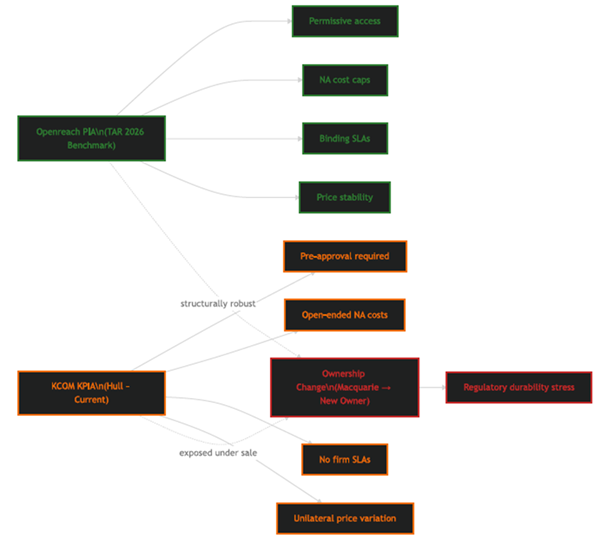
Our analysis suggests that this is a critical issue. The competitive facts on the ground are unlikely to change materially because of a sale. What may change are the incentives of the asset owner. Where obligations are explicit, SMP-anchored and owner-agnostic, they will continue to bind behaviour. Where remedies rely on voluntary or discretionary commitments, their durability becomes less certain under new ownership.
This distinction can be visualised structurally. In our Hull knowledge graph model, benchmark TAR-style PIA obligations form a tightly bound obligation bundle (permissive access, NA cost controls, SLAs, price stability). By contrast, Hull’s current KPIA framework exhibits weaker or discretionary constraints across several of these dimensions. Under an ownership stress test, the former remains stable; the latter becomes exposed.
A sale could, of course, accelerate investment or partnership strategies under new ownership, potentially strengthening competition already recognised in Ofcom’s consultation. However, from a regulatory perspective, the more immediate implication is that remedies must be designed to survive changes in ownership rather than depend upon it.
A key question for stakeholders is therefore not whether a sale accelerates competition, but whether the regulatory framework is structured to remain effective regardless of who owns the network.
Ultimately we believe that Ofcom will tighten the requirements and move towards the structures that CityFibre and MS3 have already outlined in early consultation submissions. There is still time for more submissions though, the consultation closes at the end of February.
Valuation Scenarios
Table 4. Valuation Scenarios. Source: Point Topic.
| Valuation Method | £/Unit | Total Valuation |
|---|---|---|
| Conservative | £800/premise | £231,368,000 |
| Mid-Range | £1,000/premise | £289,210,000 |
| Optimistic | £1,200/premise | £347,052,000 |
| Revenue Multiple | 5x revenue | c.£326,000,000 |
| Subscriber-Based | £2,000/sub | c.£288,000,000 |
Tier mix
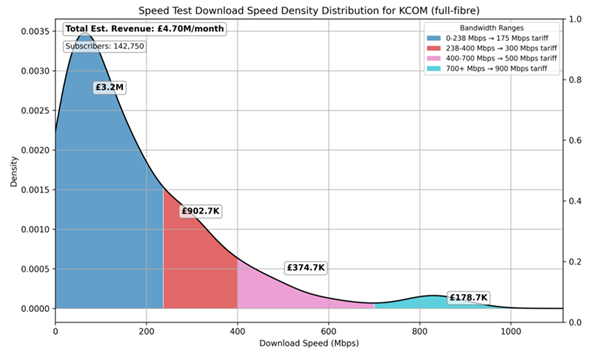
From our analysis of their speed test profile and tariff bands we get an estimate of £4.7M/month in subscription revenue and an ARPU of £32.92. This is we believe at the low end of what is actually achieved. Other methods arrive at £5.4M/month and ARPU of 39,49.
Valuation Rationale
Positive Factors (Support Higher Valuation)
- Exceptional Penetration: 50.17 % vs. UK Altnet average of 20-35%
- Nearly Pure FTTP Network: total network is almost purely fibre with minimal copper infrastructure
- Protected Market Position: Only 34.5% BT overbuild (low vs. national average)
- Stable Revenue Base: £65m annual revenue from c.145K subscribers
- Regional Dominance: 91% concentration in Hull/East Riding = market leader status
Risk Factors (Support Lower Valuation)
- Subscriber Decline: -4% YoY residential line loss (Q4 2024 → Q4 2025)
- Limited Growth Runway: 289k premises passed in a mature, concentrated market
- Geographic Concentration Risk: 91% in 2 local authorities limits diversification
- Increasing Competition: MS3 (33.4% overlap) and CityFibre Connexin (26.2%) are gaining ground
- Below-Market Speeds: Not participating in gigabit+ market (max 900 Mbps)
Comparable Transaction Context
UK Altnet acquisitions (2023-2025) have traded in the £800 - £1,200/premise range, with premium valuations for:
- High-growth assets (not applicable - KCOM declining)
- Low competitive overlap (✓ applicable - only 34.5% BT)
- High penetration rates (✓✓ applicable - 49.8%)
Valuation Range Justification: £250 - £290m represents £865 - £1,003/premise, positioned at the mid-to-lower end of comparable transactions due to declining subscriber trends offsetting high penetration benefits.
Investment Summary: "Quality Regional Asset with Defensive Value"
Why KCOM is Attractive:
- Rare High-Penetration Asset: 50% take-up rate is top-quartile for UK Altnets
- Protected Local Market: Hull/East Riding dominance with limited Virgin Media competition
- Stable Cash Generation: £65m annual revenue with strong EBITDA margins (typical FTTP)
- Strategic Consolidation Target: Fits BT/TalkTalk/Sky Yorkshire strategies; however, this is very unlikely to happen due to competition concerns.
Key Investment Concerns:
- No Growth Story: 289k premises in mature market = limited upside
- Subscriber Erosion: -4% YoY decline requires immediate attention
- Competitive Pressure Rising: MS3 and Connexin gaining share
- Product Gap: No gigabit+ offering limits premium customer capture
Would you like to gain valuable commercial insights to support your UK telecoms strategy in minutes, not weeks?
We conducted most of the above analysis by using Point Topic’s Query Agent that has access to our postcode-level UK broadband data. You can try it free of charge here.
[1] Ofcom, Promoting competition and investment in fibre networks: Hull Area Review 2026-31, Volume 1, p. 3.
Cite this: Point Topic, “Market Shake-Up Looms as KCOM Owner Explores Sale”, 12 February 2026, https://www.point-topic.com/analysis/market-shake-up-looms-as-kcom-owner-explores-sale/