
Fibre Growth, Profitability Pressure
In summary
- Total retail and wholesale fixed broadband connections reached an estimated 29.36m at the end of Q1 2026, up 13,800 quarter-on-quarter from 29.35m.
- Consumer segments accounted for approximately 27.07m connections, while retail business connections stood at 2.29m.
- Full fibre connections, defined as FTTP, FTTH and FTTB, reached 13.19m at the end of Q1 2026, up from 12.42 in Q4 2025 and 9.94m a year earlier.
- Full fibre added 775k lines quarter-on-quarter and 3.25m lines year-on-year, equivalent to 32.7% annual growth.
- FTTC/FTTx continued to contract, falling to 9.30m, while DSL dropped to 1.20m as copper migration accelerated.
- BT Group's Consumer base across BT, EE and Plusnet reached 8.224m. Point Topic records Q1 2026 quarterly net additions of 6k, and 30k year-on-year growth from Q1 2025 to Q1 2026.
- BT Consumer FTTP connections reached approximately 4.168m, representing 50.7% of BT's total consumer broadband base.
- Openreach's FTTP footprint reached 22.92m premises passed, with 8.77m FTTP connections and take-up of 38.3%.
- VMO2's combined FTTP footprint, including nexfibre, reached around 7.80m, but take-up remained low at approximately 8.2%.
- CityFibre reached 915k wholesale FTTP connections, while Netomnia reached 495k and YouFibre accelerated strongly on the retail side.
- Altnets' subscriber base reached 3.78m with 188k net additions in the quarter, up from 3.59m in Q4 2025 and 2.90m at the close of Q1 2025.
Retail (consumer and business) sector
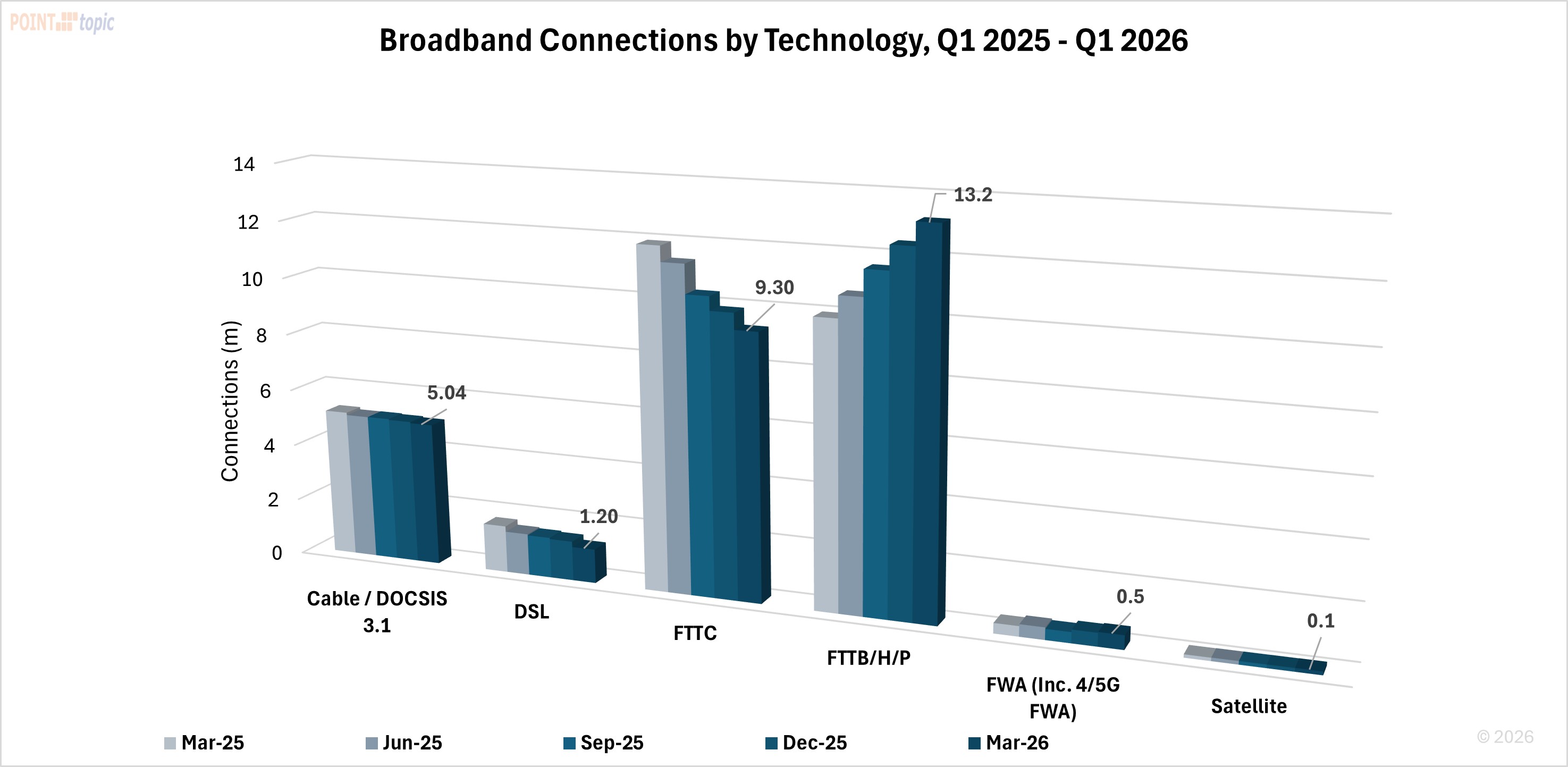
Q1 2026 saw the UK fixed broadband market remain essentially flat, with total retail B2C and B2B SME connections reaching 29.36m. Overall growth was limited to 13,800 net additions, underscoring that fibre migration is increasingly a substitution story rather than a market expansion story. Full fibre added 774,625 lines in the quarter, but this was largely offset by reductions in FTTC/FTTx, DSL and legacy cable connections.
Figure 1 Retail broadband connections by technology, Q1 2025 - Q1 2026
Source: Point Topic estimates and company reports.
Full fibre is now the largest single access technology in the Point Topic retail dataset, with 13.20m lines compared with 9.26m FTTC/FTTx lines. VMO2's DOCSIS 3.1 base declined to 5.04m, while DSL fell sharply to 1.20m. FWA, including 4G/5G fixed wireless access, continued to grow and reached 496k connections (Figure 1).
BT Group: FTTP becomes the consumer majority
BT Group's consumer broadband base across BT, EE and Plusnet reached 8.224m at the end of Q1 2026. FTTP adoption passed the halfway point, with approximately 4.168m consumer FTTP connections representing 50.7% of the total base. This marks an important inflection point: BT's retail broadband strategy is now more about monetising and retaining fibre customers than simply migrating copper lines.
The BT, EE and Plusnet brand mix remains strategically important. EE provides the premium converged proposition, BT has been reintroduced more actively across consumer products, and Plusnet remains a natural defensive brand against TalkTalk churn and value-led Altnet offers.
VMO2's fibre scale versus customer momentum
VMO2’s full fibre take-up rate was estimated at just 8 per cent at the end of Q1 across a footprint that expanded to 7.8 million premises, still materially behind Openreach’s take-up rate of more than 38 per cent and highlighting a widening gap between network scale and customer conversion. While VMO2 continues to extend its fibre footprint, the operator reported a loss of 5,300 broadband lines during the quarter, underlining the continued pressure on its legacy HFC base from Altnet overbuild, One-Touch Switching and increasingly aggressive fibre pricing.
In contrast, Netomnia added an estimated 50,000 broadband customers in Q1, reinforcing the growing momentum of larger Altnets as they shift from build-led expansion towards subscriber acquisition and penetration growth. Although the proposed Netomnia-nexfibre transaction remains under CMA review and is not yet reflected operationally, the contrasting performance of the two operators is likely to shape how investors and competitors interpret the UK fibre market over the next 12 months.
Retail business broadband overview
Retail business broadband connections stood at an estimated 2.29m at the end of Q1 2026. The business market continued to be more fragmented than the consumer market, with a sizeable long tail of specialist ISPs, resellers, channel-led providers and business-focused Altnets.
Figure 2 Top B2B providers by connections and net additions/losses, Q1 2026
| B2B provider | Q1 2026 connections | Q1 net adds/losses |
|---|---|---|
| BT Group Business Wholesale* | 674k | -7k |
| BT Group Business Retail | 566k | -5k |
| Virgin Media O2 (O2 Daisy) | 236k | 13k |
| TalkTalk Business | 144k | -2k |
| Zen Internet | 109k | -0.2k |
| Sky UK | 101k | 0.5k |
| Gamma Communications | 90k | 1.0k |
| Vodafone UK | 77k | -0.2k |
| UK Other | 44k | -23.6k |
| YouFibre | 35k | 4.6k |
| Andrews & Arnold | 25k | 0.1k |
| Hyperoptic | 17k | -0.1k |
Source: Point Topic estimates and company reports.
BT remains the dominant B2B access provider when retail and wholesale business segments are considered together. VMO2's O2 Daisy consolidation strengthens its B2B presence, while TalkTalk Business, Zen, Sky Business, Gamma, Vodafone and specialist providers such as Andrews & Arnold, ITS, bOnline and Vorboss represent the most visible long-tail business operators.
Retail new subscriber entry-level pricing trends for full fibre / gigabit-capable services
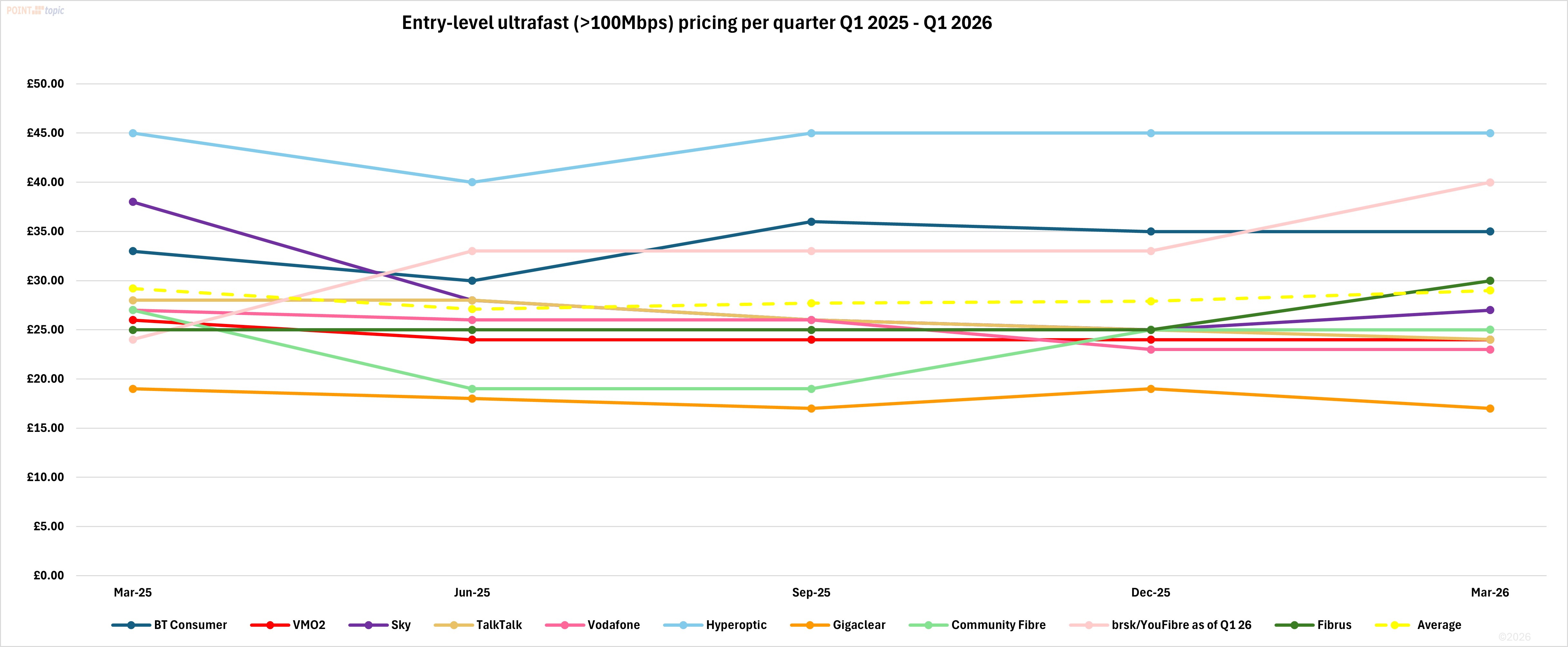
One data series that Q1 crystallised: entry-level ultrafast pricing averaged £29.00 per month in March 2026, up just 3.96 per cent from Q4 (Figure 3). The market’s self-imposed price discipline waned through the quarter as Q1 is the quarter in which annual price rises take effect and our pricing data reinforces that consumer switching accelerated in response albeit BT’s churn rates remained around 1.1%, indicating that it is pitching its pricing right for its different market demographics.
Figure 3 Retail ISPs entry-level ultrafast pricing, Q1 2025 – Q1 2026
Source: Point Topic quarterly tracking of operator tariffs carried out mid-quarter from ISP websites.
Infrastructure (wholesale) sector
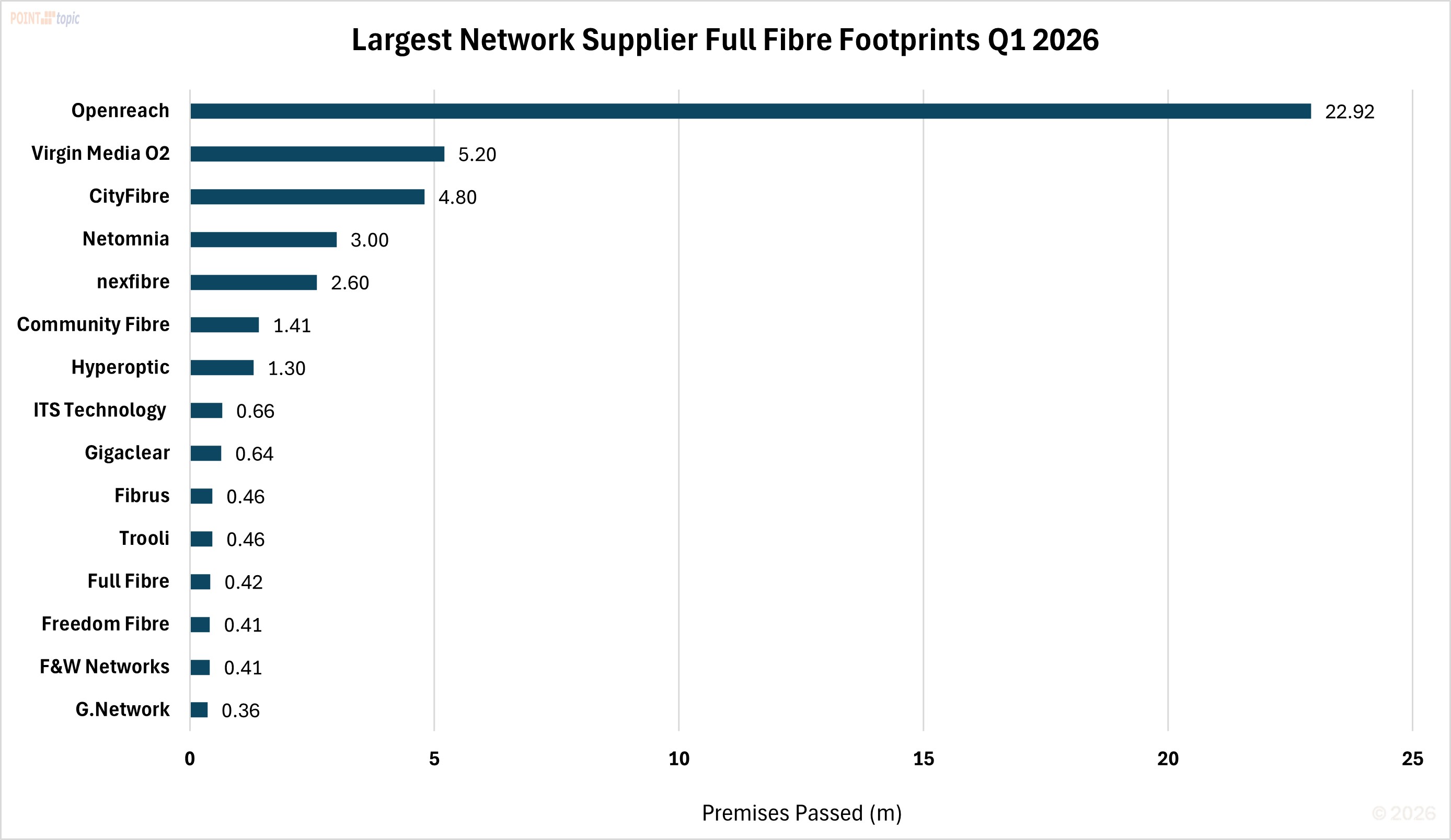
Wholesale fixed broadband connections reached 29.36m at the end of Q1 2026, up 13,800 quarter-on-quarter. Openreach's FTTP network passed 22.92m premises, while its FTTP connected base reached 8.77m. CityFibre remained the largest Altnet wholesale platform by RFS footprint among independent networks, with around 4.80m premises passed and 915k FTTP connections.
Figure 4 Full fibre premises passed by leading network operators, Q1 2026
Source: Point Topic estimates and company reports.
FTTP take-up and competitive conversion
The key competitive benchmark is shifting from footprint scale to customer conversion. Openreach remains the clear outlier in take-up performance, while several Altnets with more focused footprints also show strong penetration (Figure 5). VMO2's FTTP conversion remains notably low relative to its combined footprint.
Figure 5 Selected FTTP / gigabit-capable network take-up rates, Q1 2026
| Network | Connections | Premises passed | Take-up |
|---|---|---|---|
| Openreach | 8773k | 22.92m | 38.3% |
| toob | 105k | 0.29m | 36.2% |
| Community Fibre | 450k | 1.41m | 31.8% |
| Hyperoptic | 404k | 1.30m | 31.0% |
| Fibrus | 140k | 0.47m | 30.1% |
| Gigaclear | 170k | 0.64m | 26.4% |
| Zzoomm | 47k | 0.20m | 23.2% |
| CityFibre | 915k | 4.80m | 19.1% |
| Netomnia | 495k | 3.00m | 16.5% |
| VMO2 FTTP only | 639k | 7.80m | 8.2% |
| Trooli | 36k | 0.47m | 7.7% |
Source: Point Topic estimates and company reports.
Altnets added 188,000 FTTP subscribers in Q1, bringing their collective base to 3.78 million, up 33% year-on-year. Average take-up across the Altnets we track reached 23 per cent. But the range is wide and although slower build programmes are translating into slightly higher penetration rates, the market remains structurally saturated and highly competitive.
Outlook
Q1 2026 confirmed that BT Group ended FY26 in a materially stronger position than many investors had expected. Openreach delivered record FTTP build and connection growth, BT Consumer returned to sustained broadband growth, and FTTP now represents the majority of BT’s Consumer broadband base.
Yet despite the continued fibre acceleration, the wider UK broadband market remains structurally saturated, with competition increasingly shifting away from footprint expansion towards subscriber retention, take-up and pricing discipline. Connections continue to migrate rapidly from copper and legacy cable to full fibre, but total market growth remains limited.
The next phase of the UK fibre market is firmly focused on how operators can convert FTTP footprints into profitable long-term customers. For many Altnets, the challenge is no longer simply acquiring subscribers but retaining them while gradually improving ARPU and reducing reliance on aggressive promotional pricing. Transactions such as the proposed Netomnia–nexfibre combination are likely to accelerate a broader shift toward scale-driven fibre platforms, with smaller and mid-sized Altnets under increasing pressure to improve customer retention, raise ARPU and demonstrate sustainable long-term profitability in order to remain viable independently.
Access the full dataset
Full Q1 2026 metrics, operator-level data tables, and SPARQL access to the Point Topic knowledge graph are available to subscribers. Contact research@point-topic.com or visit www.point-topic.com to subscribe or request a trial.
About this analysis
This free analysis piece is based on Point Topic Q1 2026 estimates and company reports published to March 2026. It is provided for informational purposes. Q1 2026 figures are forward-looking context, not published data. © Point Topic Ltd 2026. Free to reproduce with attribution.
Cite this: Point Topic, “Q1 2026 UK ISP and network supplier metrics - the detailed view”, 28 May 2026, https://www.point-topic.com/analysis/q1-2026-uk-isp-and-network-supplier-metrics-the-detailed-view/