
Fixed line broadband market shows sharp signs of slowdown but broadband connections break the 29 million milestone
Summary of Key Findings
By the end of Q2 2022, the UK fixed line broadband market showed signs of a continued slowdown as the level of net adds for both the retail and wholesale sector returned back to pre-Covid pandemic levels. The number of combined consumer and business broadband subscribers saw a slight increase of 0.3% with wholesale broadband connections seeing a meagre 0.2% rise, but both sectors still managed to break the 29 million subscribers threshold. Annual price increases introduced during the quarter helped bolster BT and VMO2’s financial performances, however the challenging market conditions, network overbuild and more budget-conscious consumers opting for cheaper tariff options will see the major players struggling to maintain subscriber base or substantial revenue growth in the future.
Key Points
Total Q2 2022 FTTP, FTTx, cable, FWA/satellite and DSL wholesale connections stood at an estimated 29.02 million, up from and 28.27 million Y-o-Y; with retail consumer and business connections reaching an estimated 29.04 million up from 28.31 million Y-o-Y.
Household Internet penetration reached 89.19% with the majority of fixed broadband connections using predominately FTTP, DOCSIS 3.1 or FTTx technologies.
BT’s fixed broadband Consumer division saw 11,000 net losses in the quarter; for the first quarter since the pandemic Openreach saw a loss of broadband connections with -44,000 for the Q2.
At the close of Q2 we estimate that nearly 55% of lines live on the Openreach FTTx network belong to non-BT service providers.
Virgin Media O2 (VMO2) showed a slight improvement with their broadband net adds reaching 16,000 up from a loss of 8,000 in the previous quarter; the operator’s penetration levels continue to decline and stands at 35% of its network footprint.
On 29 July Virgin announced the creation of a GBP 4.5bn joint venture (JV) with infrastructure investor partner InfraVia, to rollout Virgin’s FTTP network to a further 2 million premises.
Sky UK remains the dominant player in its European operations with around 6.18 million UK subscribers.
AltNet providers continue their network rollouts at pace, but struggle to gain traction with subscribers due to overbuild by the major players and lack of major marketing campaigns.
AltNets FTTx (pre-dominantly FTTP/B) ISPs subscriber numbers continue to remain static and we estimate around 39,300 broadband net adds bring the total to around 2.8 million at the close of Q2 2022.
Openreach sees connections lost but revenues bolstered by inflation
Openreach’s full fibre rollout footprint covered 7.957 million homes and businesses, passing around 2.8 million premises year-on-year. Its rural build is also progressing well with 2.5 million premises passed. BT Openreach’s 'Fibre First' FTTP build programme rollout continued to accelerate, reaching record levels in the second quarter, building at an average run-rate of 59,000 premises passed per week and 763,000 throughout the quarter. The supplier is aiming to average a million premises per quarter and is not far off achieving this and has increased its target to pass a further 3.5 million premises this financial year. Openreach reported 2.073 million connections compared with 1.771 million in Q1 with overall numbers nearly doubling Y-o-Y from 1.086 million (Figure 1).
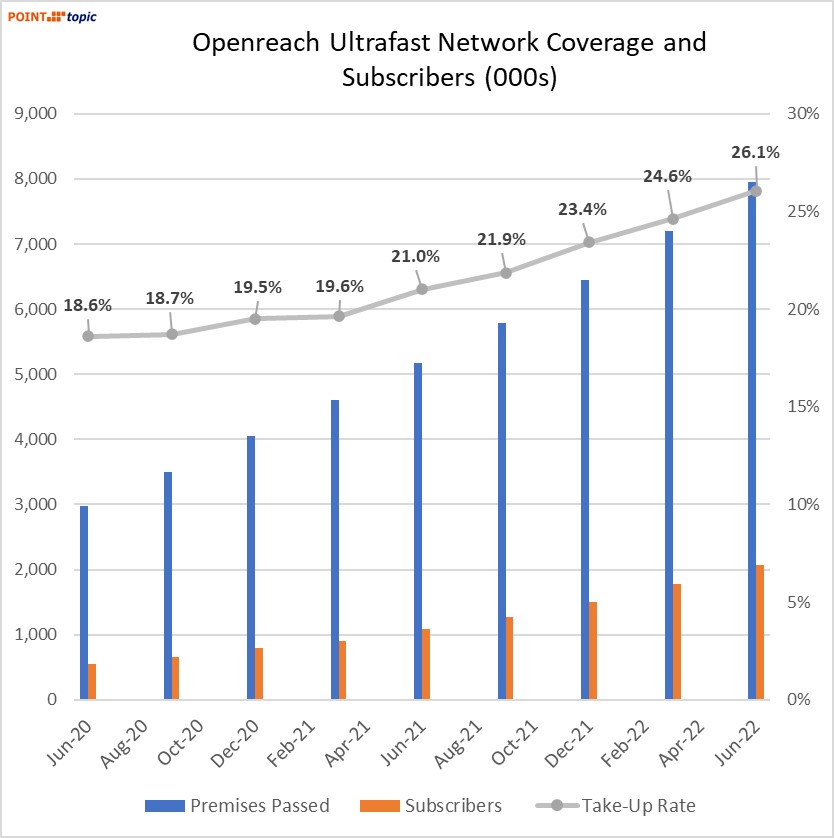
Openreach’s revenue growth saw a positive 5.2 per cent increase in the quarter up from 2 per cent in the previous. Despite connections dropping in the quarter, the growth was driven by higher rental bases in fibre-enabled products and Ethernet along with overall inflationary price increases bolstering the division’s financial performance. EBITDA grew by 5 per cent driven by lower operating costs and efficiency programmes, which was partially offset by higher FTTP provisioning activity and lower income from chargeable repairs as fibre lines are more reliable.
Openreach saw a loss of 44,000 broadband connections during the quarter, which is the first quarter in several years for the supplier to experience a loss in its subscriber base. The supplier did report that the 17,000 bad debt disconnections that were deferred from the previous quarter did go some way in explaining the overall lacklustre performance along with the reduction in voice-only lines. As AltNets start to consolidate and increase their network coverage along with VMO2s JV full fibre rollout, Openreach will likely see this trend continuing over the next year.
BT and Virgin Media O2 subscriber numbers continue to wane
The fixed line broadband subscriber market has continued to see a marked slowdown for the second consecutive quarter reaching pre-Covid levels of uptake in services. All major providers introduced tariff increases in April 2022 which saw many of the large providers experiencing slightly higher than normal churn rates at the close of Q1 2022. In Q2, this trend had stabilised however subscribers are no longer flocking to BT’s widely available, yet pricey fixed line services nor are they opting for Virgin’s reliable ultrafast packages, as consumers opt for value-for-money over speed.
BT Group saw a reduction in broadband net subscribers during the quarter with a loss of 11,000 combined consumer and enterprise connections, which is an improvement from -24,000 in the previous quarter. Virgin Media O2 reversed its poor performance in the previous quarter with net gains of 16,000 up from the net loss of 8,100 fixed line subscribers in Q1. However, BT Group as a whole will be reaping the benefits of its Consumer segment’s 9.3 per cent price increase as its overall revenue growth increased to 5 per cent up from 1 per cent at the end of March. Moreover, BT’s Consumer churn rate continued to remain stable at 1 per cent where it has remained for the past three quarters.
Virgin on the other hand, did not report such a stable quarter, with a churn rate of 13.7 per cent up from 12.2 per cent. The operator also reported a weaker revenue performance which was down by 0.6 per cent in its fixed line segment. This was due to VMO2’s milder new customer pricing options along with discount incentives given to current subscribers to increase overall retention. VMO2 tends to have a weaker Q2 as student contracts come to an end, however the overall picture is one where the Covid-related renaissance in subscriber numbers they experienced due to consumers’ flight-to-quality services, has now come to an end as its premium package pricing will prove too pricey for many budget-conscious consumers.
Wholesale connections see a levelling out
At the close of Q2 2022, we estimate wholesale connections to have reached just over 29 million. Growth in the sector has started to slow and as reported above Openreach for the first time reported a loss of connections. Increase in net broadband connections grew by 0.5 per cent quarter-on-quarter, which despite the increase in FTTP network coverage by major and AltNet suppliers is indicative that the market is reaching saturation point along with AltNet suppliers not gaining as much traction as expected within their footprints.
We estimate CityFibre, the largest independent wholesale supplier, connections to be around 94,000 up from 75,000 in Q1 and 61,500 in Q4 2021, respectively. We estimate OFNL connections to be around 90,000 up from 86,000 in Q1.
As expected, DSL lines are on the wane and dipped to 3.15 million during the quarter down from 3.36 million during the previous quarter. FTTC connections decreased to 16.4 million compared to 16.5 million in Q1 2022. FTTP ultrafast (100 Mbps+) lines are steadily progressing however and have risen to around 3.4 million up from just over 3 million in the previous quarter (Figure 2 below).
Given the fragmentation and lack of broadband penetration rates amongst the AltNet providers, it is likely that the AltNet sector will see a consolidation of operators in the future. The consolidation will result in several dominant AltNet players with expansive FTTP footprints and would logically choose to wholesale their services, creating a more competitive marketplace whilst rivalling Openreach and VMO2’s dominance in the market.
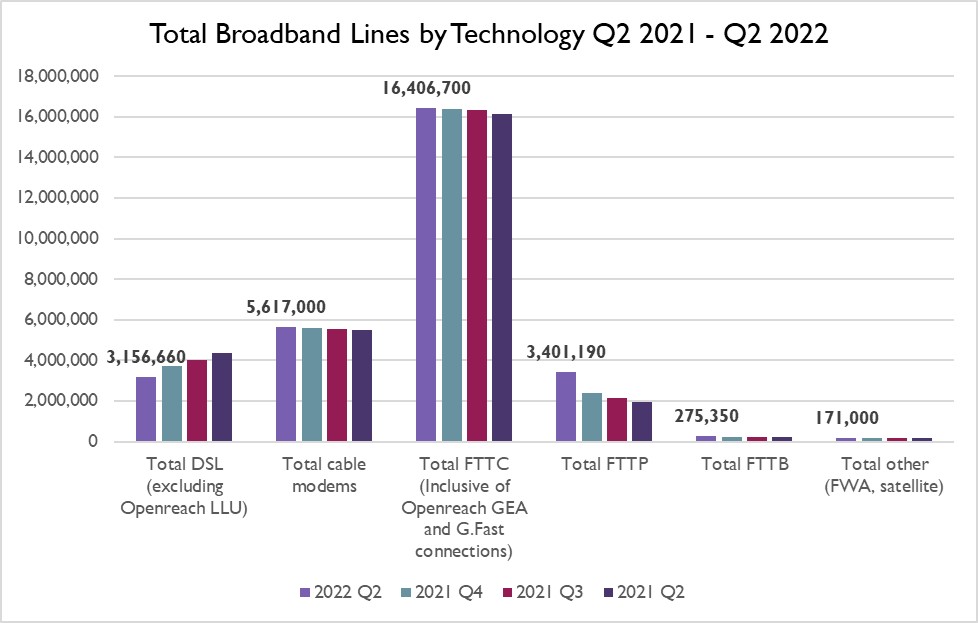
*Totals are for Openreach, CityFibre, KCOM, and Virgin Media O2 (cable modems)
The data used in this report is taken from Point Topic’s UK Plus service that allows customers to receive comprehensive, accurate and regularly updated broadband market information to support strategic decision making.
Please telephone +44 (0)20 3301 3303 or e-mail isabelle.anderson@point-topic.com for more details.
Cite this: Point Topic, “UK Q2 2022 Retail ISP and Network Operators Market Analysis”, 24 August 2022, https://www.point-topic.com/analysis/retail-isp-network-operators-uk-q2-2022/