
Q1 2023 UK retail ISP and network operators market analysis
The first quarter of the year saw the continued slowdown of the fixed-line broadband market as UK ISPs and network suppliers continue their FTTP rollouts at pace, but struggle with making massive inroads in terms of subscriber uptake.
Summary of key findings:
Total Q1 2023 FTTH/P/B, FTTC, cable, FWA/satellite and DSL wholesale connections stood at an estimated 29.23 million, up from 29.14 million q-o-q and 28.95 million y-o-y (Figure 1); with retail consumer and business connections reaching an estimated 29.05 million during Q1 2023, up from 28.96 million q-o-q and 28.44 million at the close of Q1 2022 (Figure 2).
Net broadband additions continued to slow and reached around 93k; overall y-o-y uptake growth increased by 2% which is down slightly from 2.4% when comparing 2021 to 2022 growth.
BT’s consumer FTTP customer base continues to increase taking a 16.8% share of overall connections up from 14.7% in the previous quarter, with superfast connections continuing to decrease accounting for 75.5% down from 77% previously.
Openreach’s revenue remained static at 3.4% in the quarter with the supplier reporting 202k net losses across its FTTC and copper connections, with FTTP connections picking up the slack; its FTTP connections base grew by 394k q-o-q and reached 3.123 million up from 2.729 million.
Virgin Media O2’s (VMO2s) fixed segment showed a slight improvement from Q3 with its broadband net adds reaching ~29k up from 23k bringing its broadband customer base to 5.682 million.
Comcast, Sky UK’s parent company has changed the reporting of its subscriber base and noted that previously reported total European Sky customer relationships of approximately 23 million as of 31 December 2022 also included approximately 5 million customer relationships receiving Sky services outside of the Connectivity & Platforms markets.
Bearing this in mind and following Comcast’s historical restatements, we have readjusted our Sky UK broadband subscriber estimates back to Q1 2021 (UK Plus subscribers can access these statistics in our UK Plus Quarterly Market Statistics Q1 23 spreadsheet) and estimate Sky UK to have closed the quarter with 5.653 million broadband subscribers.
Independent (or AltNet) providers saw a slight rise in take up during the quarter; out of the AltNet ISPs metrics we tracked there were an estimated 48k broadband net additions compared to 45k in the previous quarter.
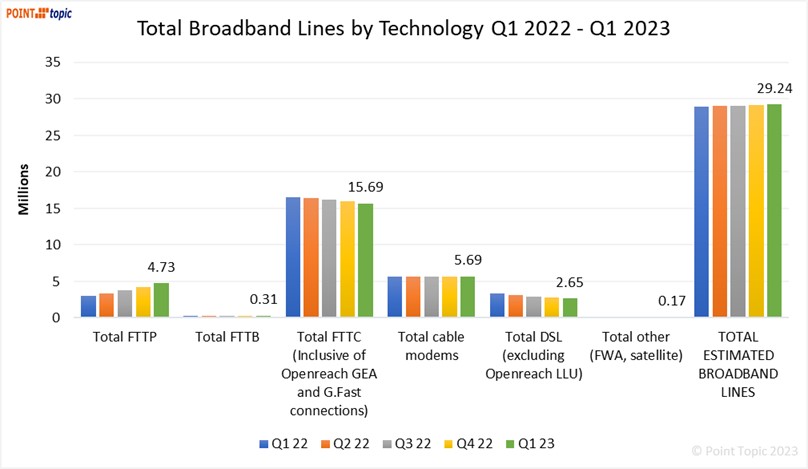
Source: Company reports where available/Point Topic estimates
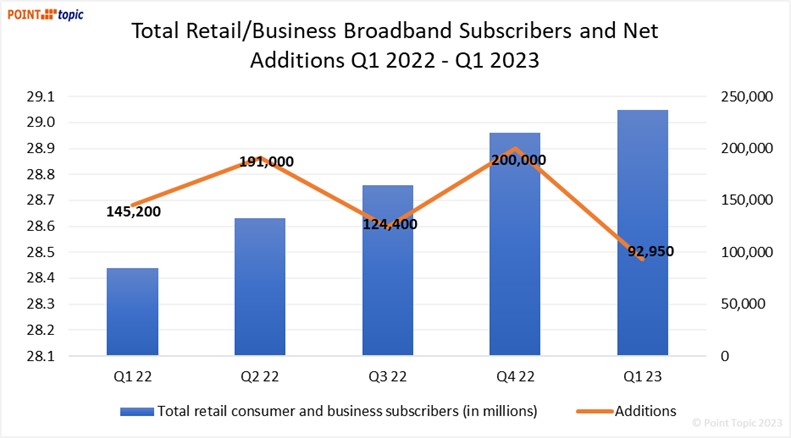
Source:Company reports where available/Point Topic estimates
BT Group closes off a challenging financial year with less than impressive performance
BT Group closed out its financial year with an unsurprisingly strong performance in the take-up of FTTP services both in its Consumer and Openreach divisions. We estimate BT Group’s retail Consumer division to have added around 17k subscribers during the quarter. The Consumer division’s churn remained at around 1.1%, which it has done so now for three consecutive quarters, demonstrating that BT’s ability to retain and switch subscribers onto full fibre tiers even when its annual price increase was higher than most providers is no small feat. However, BT should not celebrate just yet, as the lure of its ever expanding gigabit capable full fibre network has yet to attract huge swathes of new subscribers.
We estimate BT to have around 8.35 million FTTx connections at the close of the quarter with a total of 8.98 million connections via all of its technology offerings. BT reported 1.74 million FTTP connections up from 1.55 million at the end of 2022. The Group’s inflation-linked price increases have meant that the incumbent is still seeing overall revenue growth remaining positive, but only just at 0.2%. This is down from 1.6% in the previous quarter and its ARPU has also fallen to 1.2% down from 2.7%. Table 1 below provides a quarterly comparison of BT’s consumer division’s performance since Q1 2021.
Openreach reported that it has a further 6 million premises classified as ‘work in progress’ (WIP) with 3.1 million premises in its total footprint being in rural locations. Its FTTP subscriber base reached 3.12 million with weekly net adds increasing by 21.6% to 30.3k compared to 25k in Q4 2022. Its FTTP penetration rate reached 30.4% up from 28.5% in the previous quarter (see Figure 3 below).
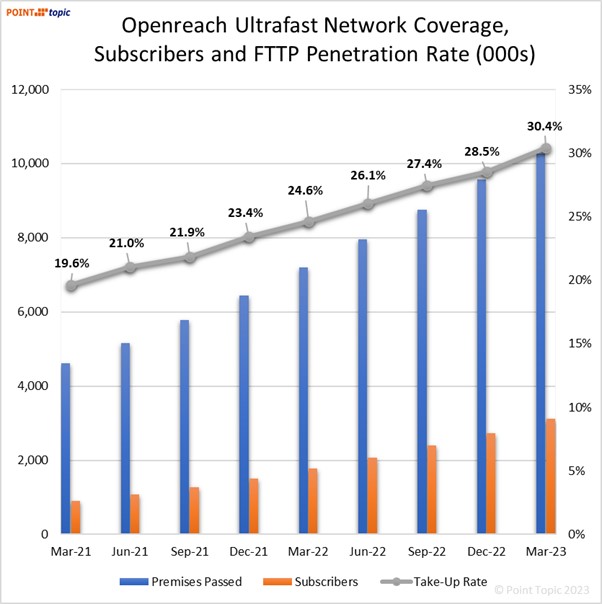
Source: BT Group Company Reports
Retail and business connections on the decline
The first quarter of 2023 saw a reduction in overall fixed broadband subscribers to reach just under 93k. This downward trend will continue over the next several quarters as consumers continue to struggle with the cost of living crisis and in some cases make the switch to mobile broadband only.
BT, VMO2, Sky, and Vodafone performed particularly well throughout 2022 with most operators reporting net additions to varying degrees. AltNets were a contributing factor as their own network buildouts expanded and additional reselling agreements increased their reach.
The AltNets are growing their subscriber bases (~45k net additions), albeit not in the huge numbers that their investors would like to see, but they are starting to make progress in slowly eroding BT’s market share.
Given the continuing cost of living crisis and further inflation-linked price increases being introduced by the top providers the market will continue to slow moving forward. Some providers that offer competitively priced data packages may see a subscriber migration to mobile-only packages to replace fixed connections, alleviating some of the churn but affecting overall revenue.
Wholesale connections remain static in challenging conditions
At the close of Q1 2023, we estimate wholesale connections to have reached 29.24 million. Similar to the retail sector, growth has begun to plateau and as reported above Openreach’s continued loss of connections. Increase in net broadband connections grew by 0.3% q-o-q and 1% y-o-y. Despite the increase in FTTP network coverage by major and independent suppliers this small level of growth is indicative that the market is reaching saturation point along with AltNet suppliers not gaining as much traction as expected within their footprints.
We estimate CityFibre (CF), the largest independent wholesale supplier, connections to be around 243k up from 170k in Q4 and 75k y-o-y, respectively. We estimate OFNL connections to be around 100,350 up from 100k in Q4 and 86k at the end of Q1 2022.
As expected, DSL lines are on the wane and dipped to 2.65 million during the quarter down from 2.83 million during the previous quarter. FTTC connections decreased to 15.69 million compared to 15.97 million in Q4 and 16.54 million the previous year.FTTP ultrafast (100 Mbps+) lines are progressing and have risen to around 4.73 million up from 4.20 million in Q4 and 3.01 million at the close of Q1 2022.
For the full report along with the complete set of data please visit our subscribers' site or email Veronica Speiser at veronica.speiser@point-topic.com for more information.
Cite this: Point Topic, “UK ISPs still navigating severe headwinds as FTTP uptake slowly gains momentum”, 30 May 2023, https://www.point-topic.com/analysis/ukfixedlinebroadbandmarketstatisticsq123/