
Ofcom's consultation on Openreach's proposed commercial offers, published on 28 July, proposes to direct Openreach to withdraw one offer and permit the rest. The document runs to 85 pages, and almost every number that would let you judge the competitive impact has been redacted.
Here is one that hasn't, from our own coverage data.
In postcode sector LS27 0 (Morley, on the south-western edge of Leeds), CityFibre has built to 191 postcodes. Openreach FTTP is already present in 184 of them.
CityFibre has seven postcodes in Morley where Openreach is not present. Ninety-six per cent of what it has built is contested by the incumbent.
The reverse comparison is the more telling one. Of Openreach's 243 postcodes in the sector, 184 also carry CityFibre, equating to 76%. Openreach meets a rival across three-quarters of its local footprint; CityFibre meets Openreach across almost all of its own. Just two postcodes in the sector have neither network present.
| LS27 0, Morley | Postcodes | Share of sector |
|---|---|---|
| Openreach FTTP and CityFibre | 184 | 73.0% |
| Openreach FTTP only | 59 | 23.4% |
| CityFibre only | 7 | 2.8% |
| Neither | 2 | 0.8% |
| Total | 252 | 100% |
Source: Point Topic
Why that number matters
The offer Ofcom proposes to block is the Incremental New to Openreach Customer Offer. It gives ISPs a £35 connection rebate and a £9.50 monthly rental rebate (for 18, 24 or 30 months depending on performance) on New to Openreach (NTO) orders above a quarterly baseline.
Ofcom's provisional view is that the resulting prices are not fair and reasonable.
The test asks whether Openreach leaves enough margin for an efficient rival to cover its own costs. Ofcom estimates those costs using its 2026 Fibre Cost Model; adjusted for the offer's £35 connection rebate, they run from £14.45 to £22.23 a month, with a midpoint of £18.34.
Openreach's discounted price falls below that midpoint in all three rebate tiers. In the deepest tier, where an ISP beats its baseline by more than 10%, and the rebate runs for 30 months rather than 18, the price falls below the bottom of the range altogether.
The mechanism that makes this bite is the baseline. Each ISP's target is set from its April 2026 New to Openreach volumes. But where an ISP has a wholesale agreement with an Altnet, it already routes almost all new connections to that Altnet where it is available. So the baseline largely captures volumes from areas where Openreach was the only option.
The consequence, which Ofcom sets out at paragraphs 4.53 to 4.59, is that in overlap areas nearly every connection an ISP diverts back to Openreach counts as above-baseline, and therefore qualifies for the discount. The offer is national in form. In practice its economic weight falls on exactly the postcodes where Altnets have built.
Which is where the 96% comes in. If almost all of CityFibre's Morley footprint is contested, then the discounted price is the price CityFibre has to compete against across nearly the whole of what it must win and not at some notional margin.
But be careful what this proves
It is tempting to read 96% as evidence that Openreach built where CityFibre built. Our data does not support that.
Across the 20 postcode sectors we examined, the share of CityFibre's footprint that Openreach overlaps is almost the same as the share of the whole sector Openreach covers. Where Openreach passes 98% of a sector's postcodes, it overlaps 98% of CityFibre's. Where it passes 58%, it overlaps 58%. The typical gap between the two is under two percentage points.
Two sectors break the pattern. In Solihull, Openreach covers 76% of postcodes but overlaps 91% of CityFibre's network; in Glasgow, 81% against 92% (Figure 1). Those gaps do suggest the two networks converging on the same ground, but they are the exceptions.
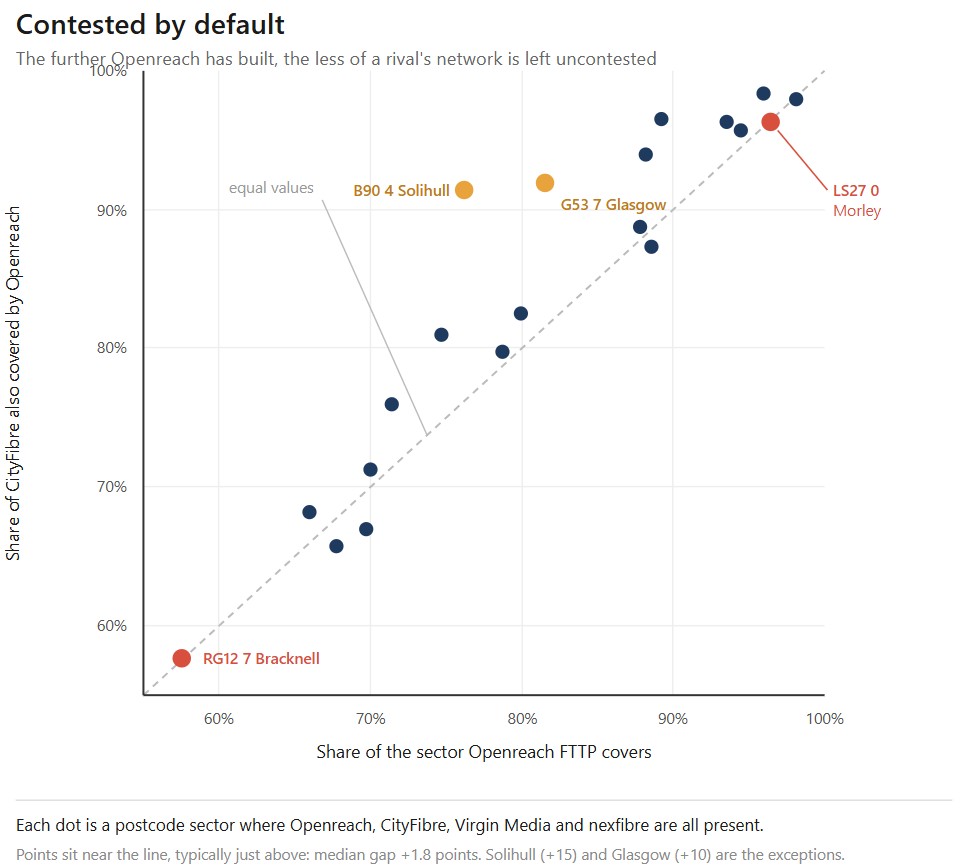
Figure 1: Twenty postcode sectors and network supplier overlap. Source: Point Topic
What the pattern shows is simpler and, for Ofcom's purposes, more relevant: Openreach is close to ubiquitous in these areas, so anywhere an Altnet builds is already contested by default. The overlap is a function of incumbency reach, not of pursuit.
That is precisely the advantage Ofcom's framework is built around. The consultation's reasoning at paragraph 4.69 turns on Openreach's unique position of having longstanding wholesale relationships, and a footprint that mostly does not overlap with alternative networks, allowing it to hold prices up elsewhere while discounting where competition exists. Altnets, facing competition across most of their coverage and locked into long wholesale contracts with capped price increases, cannot replicate that structure.
The Morley figures are that asymmetry in miniature: 96% of CityFibre's local footprint contested, against 76% of Openreach's. And Morley is one of the most heavily overbuilt sectors in the country. Across Openreach's national footprint, the imbalance is far starker. Ofcom says so at paragraph 4.70, and redacts the number.
The Bracknell sector makes the same point in reverse. Its 58% overlap is the lowest in our sample, not because CityFibre found clear ground, but because Openreach FTTP reaches only 156 of the sector's 271 postcodes. Where the incumbent has built less, less is contested.
The measurement question
Ofcom provisionally permitted a second offer which is a £50 connection rebate targeted at Virgin Media O2 areas, despite finding that it lands on Altnet territory too. Its own analysis found at least one Altnet present in 47% of the offer postcodes, covering well over half the footprints of several named Altnets. Ofcom acknowledged the overlap and allowed the offer anyway, on the basis that a £50 rebate spread across a five-year customer lifetime was too small to plausibly harm long-term competition.
Two things about that 47%.
Presence is a generous measure: Ofcom counts a network as present if it passes a single premises in a postcode. Our own data shows how much that flatters. Nexfibre registers as present in all 20 sectors we examined, yet its median footprint is a dozen postcodes out of roughly 20, and in four sectors, one. Presence answers "is anyone there", not "how much is contested".
The denominator also runs the wrong way. Ofcom asked what share of Openreach's offer postcodes contain an Altnet. The question that bears on whether an Altnet can compete is the reverse: what share of the Altnet's own footprint is contested. Ofcom gives the direction of that figure: most CityFibre premises are also covered by Openreach, but redacts the number, along with every related figure on take-up and Altnet ARPUs.
Our 96% is not a correction of Ofcom's 47%; they answer different questions. But only one was published, and it is not the one that tells you what an Altnet is up against.
What happens next
Responses close on 27 August, with a final statement expected by the end of September. Openreach can be expected to argue, as it did in its submission, that the margin should be assessed across its whole FTTP book rather than the contested slice. This is a framing Ofcom has provisionally rejected because an Altnet cannot offset thin margins the way an incumbent with a much larger backbook can.
If the direction is confirmed, the £50 geographic offer still proceeds on 1 October: same targeting logic, comparable Altnet exposure, opposite outcome, turning on the size of the discount alone.
Morley shows what that means. Just over half its postcodes carry Virgin Media's legacy cable, the footprint type the geographic offer targets, so the sector appears to sit inside both. Had the national offer survived, an ISP moving a connection here from CityFibre to Openreach would have collected all three rebates: £35 on connection, £9.50 a month, and £50 on top.
Ofcom assessed the geographic offer in isolation, on the express basis that it was proposing to block the other one. If that proposal does not survive consultation, the permission rests on an analysis that never tested the two together.
The twenty sectors
Sectors where Openreach FTTP, CityFibre, Virgin Media and nexfibre are all present. The Both OR+CF % of CF column shows how much of CityFibre's local footprint Openreach already reaches.
| Sector | Total Postcodes | OR Postcodes | OR % of Sector | CF Postcodes | Both OR+CF | Both OR+CF % of CF | Virgin Media¹ | nexfibre² |
|---|---|---|---|---|---|---|---|---|
| CV4 9 | 371 | 347 | 94% | 301 | 290 | 96% | 200 | 27 |
| CV3 2 | 329 | 263 | 80% | 275 | 227 | 83% | 263 | 74 |
| LS27 8 | 307 | 274 | 89% | 228 | 220 | 96% | 240 | 42 |
| LU2 7 | 323 | 213 | 66% | 280 | 191 | 68% | 277 | 2 |
| LS27 7 | 313 | 276 | 88% | 215 | 202 | 94% | 229 | 22 |
| G53 7 | 335 | 273 | 81% | 248 | 228 | 92% | 218 | 1 |
| CV5 6 | 249 | 239 | 96% | 180 | 177 | 98% | 188 | 88 |
| LS14 6 | 327 | 309 | 95% | 140 | 134 | 96% | 234 | 1 |
| CV2 1 | 304 | 212 | 70% | 215 | 144 | 67% | 233 | 9 |
| RG30 4 | 257 | 180 | 70% | 237 | 169 | 71% | 221 | 29 |
| S60 5 | 288 | 253 | 88% | 151 | 134 | 89% | 227 | 23 |
| RG12 9 | 273 | 215 | 79% | 188 | 150 | 80% | 186 | 63 |
| B90 4 | 311 | 237 | 76% | 174 | 159 | 91% | 228 | 1 |
| RG12 7 | 271 | 156 | 58% | 243 | 140 | 58% | 211 | 13 |
| CV2 3 | 227 | 201 | 89% | 197 | 172 | 87% | 218 | 4 |
| CV6 2 | 213 | 209 | 98% | 197 | 193 | 98% | 200 | 10 |
| LU3 1 | 241 | 180 | 75% | 215 | 174 | 81% | 220 | 1 |
| LS27 0 | 252 | 243 | 96% | 191 | 184 | 96% | 150 | 22 |
| SL2 5 | 266 | 190 | 71% | 212 | 161 | 76% | 191 | 3 |
| NN8 3 | 242 | 164 | 68% | 207 | 136 | 66% | 211 | 8 |
Source: Point Topic
¹ Virgin Media figures are Project Mustang FTTP only, and exclude the legacy cable and RFoG footprints. Virgin Media's total coverage in these sectors is therefore higher than shown.
² nexfibre's median footprint across these sectors is twelve postcodes; in four it is a single postcode. Presence, not scale.
Method and caveats
Coverage data from the Point Topic premises passed database, at postcode level; the database does not carry UPRN-level joins, so all figures are postcode presence counts. This is the same resolution Ofcom used, and it carries the same limitation for our figures as for theirs: a postcode counts as covered when a network passes at least one premises in it, so overlap does not establish that both networks pass the same homes. Where this piece describes postcodes as contested, that is shorthand for both networks being present.
LS27 0 was selected for vintage alignment: the Openreach layer dates from March 2026 and the CityFibre layer from February 2026, one month apart and contemporaneous with the January 2026 coverage data Ofcom used in its own analysis. Other sectors in the sample carry gaps of up to 22 months and were excluded from the headline figure for that reason.
The LS27 0 figures were re-queried independently of the sector ranking that produced them and returned identical counts, with a full coverage breakdown reconciling to the sector total: 184 postcodes with both networks, 59 Openreach only, 7 CityFibre only, 2 with neither.
The CityFibre layer used is the Vodafone reseller variant, the largest of CityFibre's reseller footprints but a subset of its total build. The true overlap figure is therefore likely to be understated.
Virgin Media coverage is recorded across separate layers. In LS27 0, legacy cable passes 131 postcodes and the Project Mustang FTTP overlay 150, with 128 in common. The cable layer carries records dating to December 2019, but these are data vintages rather than build dates, so they do not distinguish 1990s legacy build from Project Lightning, both of which fall within the geographic offer's scope. We have not seen Openreach's published offer postcode list, so the sector's inclusion is inferred from footprint type rather than confirmed. Virgin Media figures in the wider 20-sector sample refer to Project Mustang FTTP only.
One robustness note: a Coventry sector in the sample shows 98% overlap on an Openreach layer that is 22 months stale. Its actual figure can only be higher.
Cite this: Point Topic, “Where the NTO discount lands: Ofcom, Openreach and overbuild”, 28 July 2026, https://www.point-topic.com/analysis/where-the-nto-discount-lands-ofcom-openreach-and-overbuild/