
There are question marks and some nerves apparent around the deployment of FTTP in the UK today.
Openreach reported only 2.5% growth in traffic in the last 12 months. Can you move enough customers from FTTC/your FTTP competitors quickly enough to satisfy investors?
Will the customer cut back (or pay more for) the upgrades? How quickly will they buy and which tier will it be and what does that mean for your bottom line?
Who will survive and how? Who are the safe bets and who will be under threat?
As is traditional the answer to all the above is ‘it depends’.
FTTP is coming to the UK. The decision is not which technology you want to deploy as a (fixed) operator/ISP but where and for who.
The initial adoption curve for FTTP in the UK was quite steep and perhaps resulted in some optimistic assumptions in business models. Now that Openreach and Cityfibre have started serious roll-out we are seeing a flatter curve which in combination with more cost conscious pool of subscribers suggests a more pragmatic set of assumptions is appropriate. There are also signs of more mobile substitution for fixed as bandwidths improve in some areas and mobile traffic appears to be increasing rapidly.
The key metrics are:
How much gigabit+ competition will you face in your deployment footprint
What tariff tier (and bundle) mix can you achieve and in what timeframe
Will you be able to compete on price and discounting during the first few years of subscriber acquisition? Do you have enough runway and investment to weather low margins or can you build a base with a healthier mix of tariff tiers and minimise your need to compete on price?
Are you structurally capable of absorbing other networks or of being absorbed yourself? Consolidation is coming and at some point an operator will face a choice (or necessity) of buying or being bought.
How much does an individual household actually use or want?
ISPs will offer several tiers of bandwidth and we generalise those into low, medium and high. Low bandwidth, low cost very few bells and whistles on through to the high end, red carpet internet on ramps with more bandwidth than any of your neighbours, static IP addresses, cloud storage and routers than can double as BBQs.
ISPs however won’t tell you what proportion of their customers take which tier.
This is what it looked like in 2012 from Ofcom data:
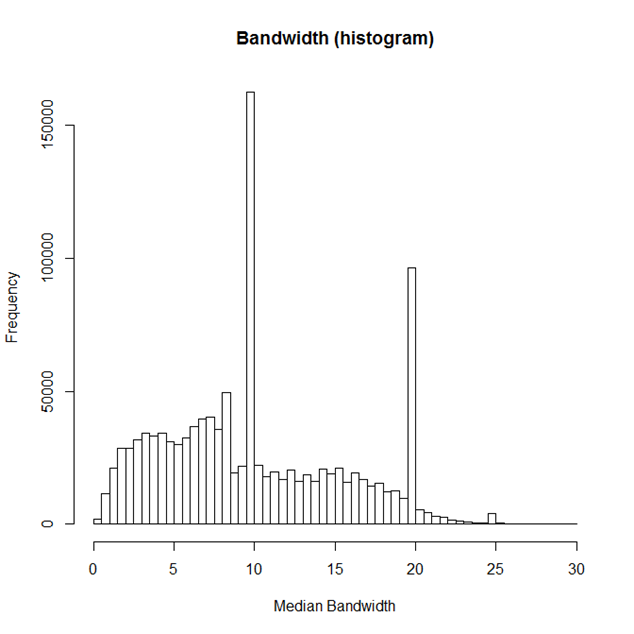
This does give us some insight into the tier mix at the early stages of a new technology roll-out. With FTTC making inroads into a previously ADSL dominated market.
And this is what the last few years look like for FTTC. We use density plots of speed tests from our thinkpoint product, rather than frequency to allow better comparison.
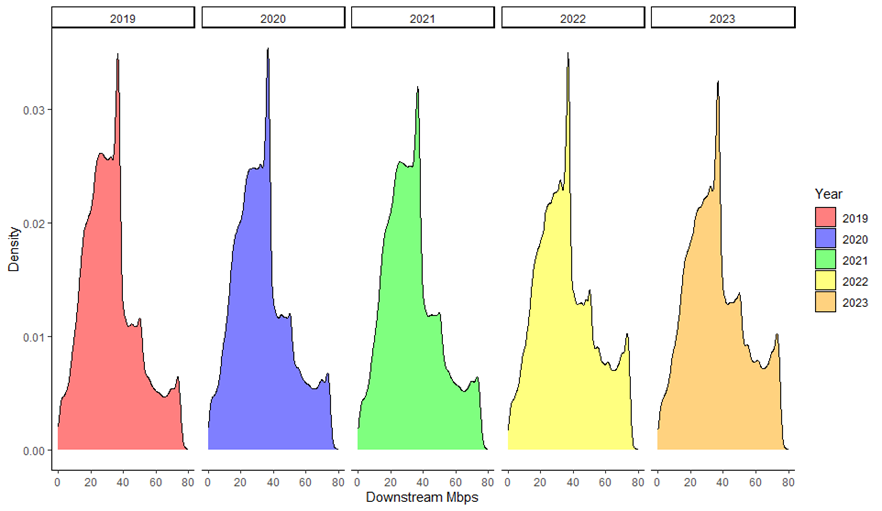
We can see there does appear to be some hunting for bandwidth from 2019 to 2023 with the peak at 70+Mbps growing as more users subscribe to the upper tiers. Around 7% of test counts shifted from the lowest to the medium (2% gain) and the highest (5%) tiers from 2019 to 2023 (q1).
FTTP is still settling down in our data as the ISPs update offerings, target specific areas and look to move early adopters up the tariff tiers or even sell them bundles.
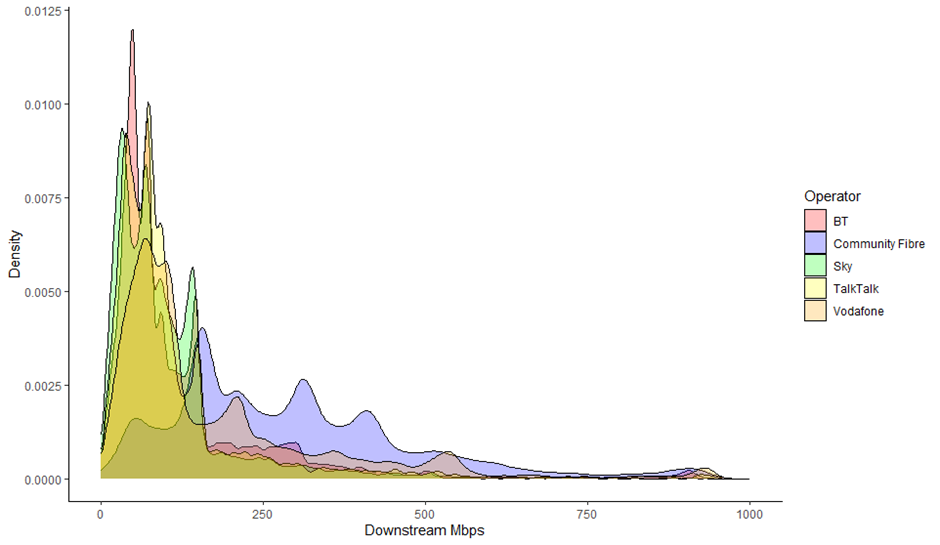
While the industry is still trying to sell based on speed as a primary distinguisher the impact has lessened and will continue to do so as customers go number blind. After all who can count that many 0’s and differentiate a 10Gig connection from 1000Mbps.
A homogenous technology may be good for network management but it presents a different challenge in terms market segmentation for the ISPs and they will have to compete on brand and reputation as well as what services they can offer (TV bundles, wifi extenders etc.) and perhaps most importantly on price.
That will be much harder for the smaller operators and deep pockets that enable discounts (£5 off Netflix and your password sharing paid for example) are an unattractive but effective tool for ISPs and along with Ofcom’s desire/necessity to see stable operator coverage, particularly in less commercially viable areas it will be a big challenge to survive.
It will be possible to thrive though.
Subscribers to UK Plus can read our full report for more data, analysis and details.
Cite this: Point Topic, “FTTP in the UK. Is it worth it?”, 22 February 2023, https://www.point-topic.com/analysis/worth-fttp-fibre-uk/