
UK broadband availability in Q1 2026: Openreach FTTP premises exceed 22m

This is our regular update on fixed broadband availability in the UK, tracking the progress to the end of Q1 2026. The analysis is based on our broadband availability dataset which covers all 1.7m UK postcodes. More granular, postcode level broadband availability updates by operator and technology (quarterly and monthly), are available to our UK Broadband Mapping customers. Also, for a limited time, we made our comprehensive Local Authority level data and Ward level maps available for free here.
Note: There will generally be a lag to the operator announcements for premises passed at the time since it takes us time to properly track and audit any new deployments, unless the operators tell us about them. Also, we report RFS (ready for service) premises, while some operators and ISPs include premises where customers can pre-order a broadband service.
Key headlines
At the end of Q1 2026, FTTP covered 82.9% of the UK premises, compared to 80.5% at the end of Q4 2025. Gigabit coverage was 89.3%.
Openreach FTTP footprint stood at 22.1 million premises, up 6.3% quarter-on-quarter. Their legacy networks covered 11.1 million premises, down by 8.8%.
13.4 million premises had access to two or more FTTP networks (up by 6.7% since the previous quarter). Almost 2.5 million premises were covered by 3+ fibre networks.
Several local authorities experienced notable growth in FTTP premises, with standout increases including Na h-Eileanan Siar (81.6%), Harlow (39%), Warwick (22.7%), and South Tyneside (21.3%).
Nationwide 2.8 million premises could choose between two or more fibre altnets, compared to 2.5 million in Q4 2025, but we expect the overbuild to be slowing down due to cost pressures and consolidations.
Openreach and FTTP premises in general
In Q1 2026, we recorded 1.3m additions to the full fibre premises passed by Openreach, compared to 1.1m additions in Q4 2025. So, full fibre rollout accelerated further. Our total recorded Openreach FTTP footprint stood at 22.1 million premises, up 6.3% quarter-on-quarter (Table 1). If Openreach maintain this pace of just over a million premises a quarter, they are on track to reach their target of 25 million fibre premises by the end of 2026. Openreach full fibre now covers 65.3% of all UK premises, up from 61.5% in Q4 2025.
The number of Openreach ADSL, FTTC only and Gfast only premises went down by 1.07m. These legacy networks still covered 11.1 million premises in the UK but this figure decreased by 8.8% quarter on quarter, and it is now only half the number of the FTTP premises.
Table 1. Openreach footprint by technology, Q1 2026. Source: Point-Topic.

Northern Ireland LAs are prominent among the top 20 local authorities covered by Openreach’s fibre - Belfast leads with 96%, and the top 10 LAs include 5 NI councils (Figure 1). Wirral is the highest performing English LA (95%), while Flintshire is the best covered in Wales (93%). Overall, Openreach maintains strong position on the UK periphery and in Northern regions, not least due to government intervention schemes.

In Q1 2026, the overall FTTP coverage, including Openreach FTTP network, altnets, Virgin Media O2’s fibre network and KCOM was 28.1 million premises (82.9% of the UK total, compared to 80.5% at the end of Q4 2025). The number of FTTP premises went up 3% q-o-q, with the growth slightly accelerating from 2.2% in the previous quarter. Gigabit coverage (including Docsis3.1) was 89.3%.
Fibre network overbuild has increased further. At the end of Q1 2026, 13.4 million premises had access to 2 or more FTTP networks (up by 6.7% since Q4 2025). Almost 2.5 million premises were covered by 3+ fibre networks, with this number having increased by 14.1%.
Table 2. Changes in FTTP network overbuild (all networks). Source: Point Topic.

The progress of FTTP deployment by multiple operators made our ‘list of shame’, which shows the bottom ten LAs by FTTP coverage, slightly less scathing (Figure 2). Even the very bottom council of Shetland Islands increased FTTP coverage to 19.7%, while Harlow at the top of the list reached 53.2% coverage (39% up quarter-on-quarter). Compared to the previous quarter, the bottom ten LAs stayed the same, however, only changing their order.

In Q1 2026, South Tyneside, North Yorkshire and County Durham added most FTTP premises (more than 10K each). In this category, Enfield and Telford have the longest way to go, with only 61% and 65% of their premises respectively covered by FTTP. County Durham is approaching full coverage, with 88%.

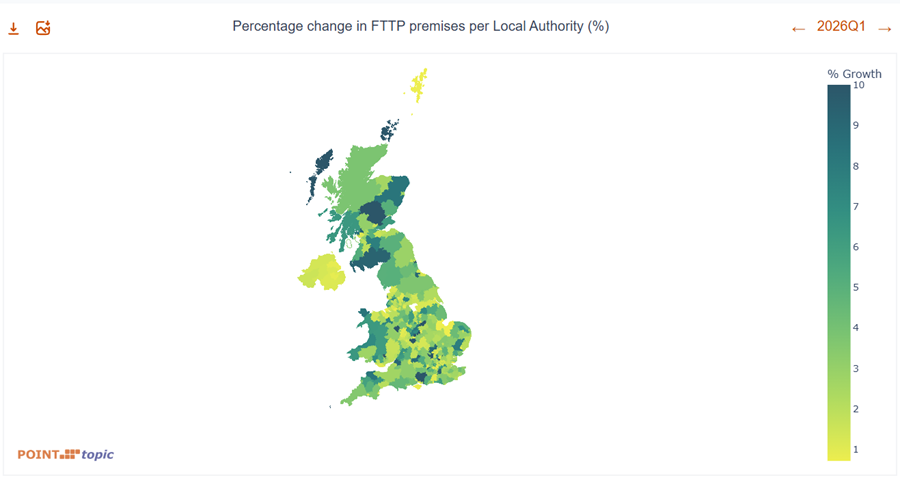
The overall picture of FTTP premises added across the UK can be seen on the following map.

Nationwide, several local authorities experienced notable percentage growth in FTTP premises (Figure 5), with standout increases including Na h-Eileanan Siar (81.6%), Harlow (39%), Warwick (22.7%), South Tyneside (21.3%), Telford and Wrekin (16%).
Fibre Altnets: overbuild continues but is likely to slow down
Among the altnets exceeding 100K fibre premises passed, CityFibre remained at the top of the league with 4.2m FTTP premises (Ready for Service premises) (Figure 6). Netomnia, Nexfibre, and Community Fibre had the next largest footprints with 3m, 2.4m and 1.4m premises respectively[1]. (From this quarter our reported Netomnia’s premises include brsk).
Netomnia recently attracted interest from Nexfibre, and if the deal goes ahead (it is currently under review by the CMA), Nexfibre will more than double their footprint. The combined footprint could reach 8 million premises by the end of 2027, which when combined with Virgin Media’s network could reach 20 million UK premises and create a serious challenger to Openreach.

[1] See our earlier note about possible lags to the operator announcements of premises passed.
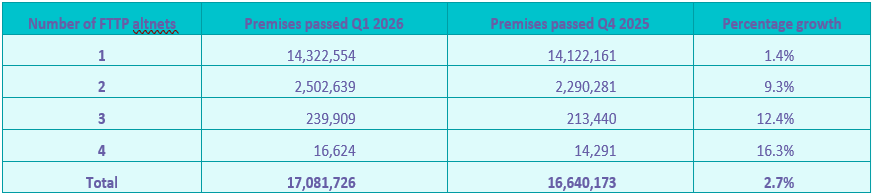
Overbuild by FTTP altnets has increased further, even though many operators are focusing on increasing the take-up rates. In Q1 2026, 2.8m premises could choose between two or more fibre altnets, compared to 2.5m in Q4 2025 (up by 9.6%). Nearly 257K of premises were served by 3 or more alternative fibre networks, up from 228K three months earlier (Table 3). We are expecting overbuild to slow down as market consolidation continues, the Iran war impacts energy and other costs and supply chains, and the ‘Fibre tax’ goes up.
Table 3. Altnet overbuild evolution. Source: Point Topic.
The complete dataset used to produce this analysis is part of our UK Broadband Mapping at postcode level. You can also access our comprehensive data at Local Authority level, including broadband maps at ward level that highlight where the broadband infrastructure is in place, and where it’s still catching up.
If you have any questions, you can contact us on 020 3301 3303 or by e-mail oliver.johnson@point- topic.com


Comments