
UK broadband coverage in Q2 2026: full fibre reaches 84.5% of premises as Openreach's FTTP rollout slows down

This is our regular update on fixed broadband coverage in the UK, tracking progress to the end of Q2 2026 (as of 30 June 2026). The analysis is based on our broadband availability dataset, which in this edition covers 1.76 million UK postcodes and 33.9 million premises. More granular, postcode-level broadband availability data by operator and technology is available to our UK Broadband Mapping customers, along with Local Authority-level data and ward-level maps.
Also, as of today, Point Topic's broadband ontology — the structured map of operators, networks and the relationships between them — is available to any AI assistant that speaks the Model Context Protocol, with no account and no API key. For more details see this post or talk to one of our team members at Connected Britain 2026.
Note: as in previous editions, there is generally a lag between an operator's own announcements of premises passed and our figures, since it takes us time to properly track and audit new deployments unless operators tell us directly. Also, note that our UK total premises count may differ from other sources.
Key headlines
As of 30 June 2026, overall FTTP broadband coverage reached 84.5% of UK premises, up from 83.0% in Q1 2026 on a like-for-like operator basis (see Table 2 note).
Openreach's FTTP footprint stood at 22.8 million premises, up 2.8% quarter-on-quarter — a significantly slower pace of growth than the 6.3% recorded in Q1 2026. Their legacy networks (ADSL, FTTC and G.fast) covered 10.5 million premises, down 5.5%.
15.7 million premises (46.3% of the UK total) had access to two or more FTTP networks, up from 43.2% in Q1 2026. Further 4.2 million premises (12.4%) had 3+ networks, up from 10.4%, and 0.37 million (1.1%) had 4+, up from 0.8%.
Northern Ireland remains the best-covered UK nation for any-network FTTP (97.1%), ahead of Wales (87.6%), England (84.7%) and Scotland (77.2%). Belfast again leads the LA table at 96.4% Openreach FTTP coverage, with five Northern Ireland councils in the top ten.
CityFibre remains the largest FTTP altnet by footprint at 4.25 million premises, with Netomnia You Fibre (3.30 million) and nexfibre (2.63 million) next largest.
Buckinghamshire added the most any-network FTTP premises of any local authority in Q2 2026 (+10,343, taking coverage to 80.0%), followed by Stevenage (+9,863, to 92.3%) and Harrow (+8,993, to 88.4%).
Openreach and FTTP premises in general
In Q2 2026, Openreach's full fibre footprint grew by 625K premises, compared with 1.3 million in Q1 2026. So, the pace of full fibre rollout slowed down to less than half the rate seen in the previous update. The slowdown could be due to the operator moving into harder to reach areas.
Our total recorded Openreach FTTP footprint stood at 22.8 million premises, up 2.8% quarter-on-quarter (Table 1), and Openreach full fibre now covers 67.2% of all UK premises, up from 65.3% in Q1 2026. If Openreach were to maintain this quarter's slower pace across the second half of the year, they would end 2026 noticeably short of their stated 25 million premises target. Reaching it would require the pace to pick back up well beyond Q2’s level.
The number of Openreach ADSL, FTTC-only and G.fast-only premises fell by 608K. These legacy networks still covered 10.5 million premises in the UK, down 5.5% quarter-on-quarter — a gentler decline than the 8.8% recorded in Q1 2026, which is not surprising given slower FTTP rollout. Legacy premises are now well under half the number of FTTP premises.
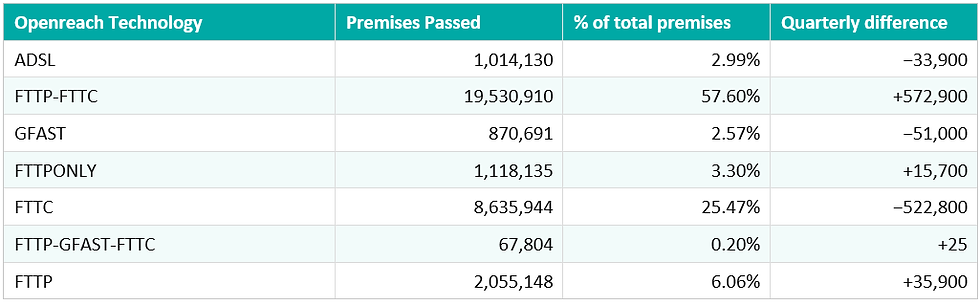
'Unknown' and unclassified premises (around 0.6 million combined) are excluded from this table, consistent with the previous edition.
Northern Ireland LAs remain prominent among the top LAs covered by Openreach's fibre — Belfast leads with 96.4%, and the top ten LAs include five Northern Ireland councils (Figure 1). Wirral is again the highest-performing English LA (94.9%), while Flintshire remains the best-covered LA in Wales (93.2%), both essentially unchanged on Q1 2026. Openreach maintains a strong position on the UK periphery and in Northern regions, not least due to government funding.

All-network FTTP coverage and overbuild
As of 30 June 2026, the overall FTTP coverage, including Openreach FTTP, CityFibre, Virgin Media O2's RFOG and XGSPON networks, nexfibre, KCOM and altnets, reached 28.7 million premises (84.5% of the UK total, up from 83.0% in Q1 2026 on the same operator basis — see the note under Table 2). Gigabit coverage (including DOCSIS3.1) was 89.2%, up from 88.6% in Q1 2026.
Fibre network overbuild is more extensive than the previous edition's methodology captured, once Virgin Media's XGSPON build and nexfibre Virgin Media are included alongside Openreach FTTP, CityFibre and other altnets. Table 2 below restates Q1 2026 figures on this same, wider operator basis so the two quarters are comparable. On this like-for-like basis, premises with access to two or more FTTP networks rose from 43.2% in Q1 2026 to 46.3% in Q2 2026, three-or-more rose from 10.4% to 12.4%, and four-or-more rose from 0.8% to 1.1% — a genuine, if modest, further deepening of overbuild, concentrated in the areas that already had multiple networks rather than newly-overbuilt areas.

Network counts combine: Openreach FTTP, KCOM FTTP, Virgin Media's RFOG and XGSPON as one Virgin Media network, nexfibre Virgin Media as a separate network, CityFibre and other FTTP altnets. Both the Q2 2026 and Q1 2026 columns above are calculated on this wider operator basis.
The picture across UK nations continues to be uneven (Figure 2). Northern Ireland leads on any-network FTTP coverage at 97.1% (little changed from 96.9% in Q1 2026), ahead of Wales (87.6%, up from 85.9%) and England (84.7%, up from 83.2%), with Scotland lowest at 77.2% (up from 75.4%), weighed down by its island and rural authorities. (All Q1 2026 comparisons here are recalculated on this edition's wider operator basis.)

Bottom-performing LAs by FTTP broadband coverage
Our 'list of shame', showing the bottom ten LAs by any-network FTTP coverage, has seen some changes in the order rather than composition: West Dunbartonshire has jumped above Aberdeenshire and Harlow, having increased its FTTP coverage to 55.9% (Figure 3). Shetland Islands remains bottom at 19.7%, unchanged since Q1 2026. Na h-Eileanan Siar and Argyll and Bute saw the fastest underlying growth in this ranking, with FTTP premises up 24.4% and 15.3% respectively on Q1 2026, though both remain among the lowest-covered LAs in percentage terms.

Leading LAs by FTTP footprint
Buckinghamshire added the most any-network FTTP premises of any LA in Q2 2026 (10,343, taking coverage to 80.0%), followed by Stevenage (9,863, to 92.3%) and Harrow (8,993, to 88.4%) (Figure 4). The list is dominated by London's outer boroughs and the wider South East and East of England — Barnet, Central Bedfordshire, Bedford, Brent, Welwyn Hatfield and Woking all feature — alongside Birmingham, the only large city to make the top ten. This mix of already well-covered commuter-belt LAs (most in the list are above 80% coverage) suggests altnet and Openreach build this quarter was concentrated on infilling and overlapping existing footprints as much as reaching new areas.

Premises added is calculated as any-network FTTP premises in Q2 2026 minus any-network FTTP premises in Q1 2026, both computed at postcode level using the same operator combination as Table 2, then summed to LA level. Because each postcode is counted once regardless of how many networks are present, this avoids double-counting premises reachable by more than one network.
The overall picture of FTTP premises added across the UK can be seen on the following map.

The darkest patches sit around Buckinghamshire/Hertfordshire, West Yorkshire (Leeds area), and the Scottish Highlands, which stands out because it's added a large absolute number of premises despite a much smaller population base than the southern LAs.

In terms of percentage growth, Scotland dominates even though it added fewer premises in absolute terms (weighted average +2.4% vs +1.8% nationally). Stevenage is the standout at +33% (from a small base), and Na h-Eileanan Siar continues the rapid growth flagged in earlier editions (+24%). Argyll and Bute (+15%) and several other Scottish island/rural authorities also stand out — the same pattern the "list of shame" bottom-ten table showed, of small, low-coverage LAs growing fastest in percentage terms precisely because they started from so little.
Fibre altnets: overbuild deepens, though the field looks set to consolidate further
Among altnets with a meaningful footprint, CityFibre remains at the top of the league with 4.25 million FTTP premises passed, up modestly by 0.6% from Q1 2026 (Figure 5). Netomnia You Fibre grew by 8.5% to 3.3 million, while nexfibre Virgin Media’s footprint increased by 9.2% to 2.63 million.
As we reported last quarter, the proposed acquisition of Substantial Group — Netomnia, YouFibre and Brsk — by the Liberty Global/Telefonica/InfraVia-owned nexfibre is worth around £2bn. The significant new development during the period was regulatory: on 1 July the CMA (the Competition and Markets Authority) sent the transaction directly to an in-depth Phase 2 investigation, at the parties' request under the fast-track procedure. BT, CityFibre, Grain, Hyperoptic and Sky have subsequently submitted views to the CMA, illustrating how important the transaction is for the future of infrastructure competition.

Note: Onestream acquired Cuckoo's broadband customer base in May 2026, meaning Onestream now manages Cuckoo services behind the scenes.
Overbuild among altnet FTTP networks grew again across the board: premises reachable by two or more altnet FTTP networks rose 5.1% quarter-on-quarter, and premises with three or more rose 6.3%. Total altnet FTTP premises increased by 2.6%.
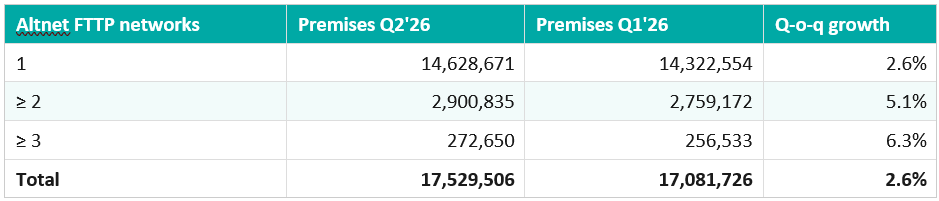
However, the last few months have been unusually active in terms of market consolidation. Probably the most significant distressed infrastructure consolidation announcement was about Voneus acquiring Airband’s assets and customers (28th August 2026). The enlarged operation will cover 170,000 ready-for-service gigabit premises and 60,000 customers. Airband's shareholders and lenders absorbed very substantial losses, and the assets went to another rural altnet for a fraction of historic investment.
Meanwhile, On 10 June, reports emerged that Warburg Pincus had appointed advisers and approached buyers for Community Fibre, while KKR had contacted potential purchasers of Hyperoptic. A merger of the two operators had reportedly also been considered. The scale makes this especially important: Community Fibre: about 465,000 customers and 1.5m premises covered; Hyperoptic: 440,000 customers and about 1.3m homes ready for service.
One important signal is that take-up and cash generation now matter more than just premises passed numbers. Airband demonstrates how little value a network can retain if customer penetration and economics are weak. Conversely, Community Fibre's comparatively strong customer base and improving EBITDA give its owners considerably more strategic options.
Access the full dataset
The complete dataset used to produce this analysis is part of our UK Broadband Mapping product, available at postcode level.
Also, check out our broadband ontology which features the structured map of operators, networks and the relationships between them. It is now available to any AI assistant that speaks the Model Context Protocol, with no account and no API key: https://mcp.point-topic.com/
If you have any questions, you can contact us on 020 3301 3303 or by e-mail at oliver.johnson@point-topic.com.


Comments