
Research Round-up September 2026

Key publication of the month:
This is our regular update on fixed broadband coverage in the UK, tracking progress to the end of Q2 2026 (as of 30 June 2026). The analysis is based on our broadband availability dataset, which in this edition covers 1.76 million UK postcodes and 33.9 million premises.
Key headlines
As of 30 June 2026, overall FTTP broadband coverage reached 84.5% of UK premises, up from 83.0% in Q1 2026 on a like-for-like operator basis (see Table 2 note).
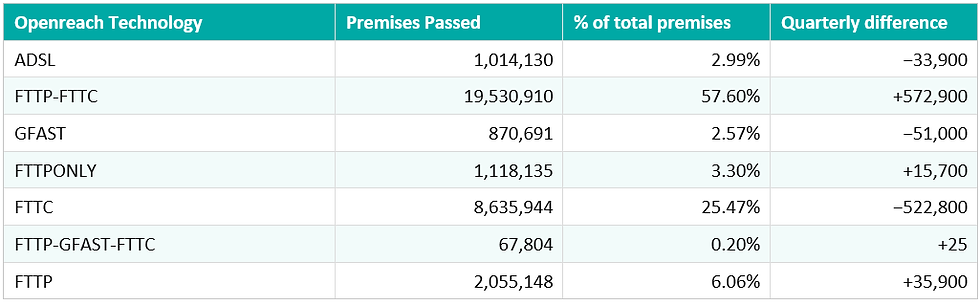
Openreach's FTTP footprint stood at 22.8 million premises, up 2.8% quarter-on-quarter, a significantly slower pace of growth than the 6.3% recorded in Q1 2026. Their legacy networks (ADSL, FTTC and G.fast) covered 10.5 million premises, down 5.5%.
15.7 million premises (46.3% of the UK total) had access to two or more FTTP networks, up from 43.2% in Q1 2026. Further 4.2 million premises (12.4%) had 3+ networks, up from 10.4%, and 0.37 million (1.1%) had 4+, up from 0.8%.
Northern Ireland remains the best-covered UK nation for any-network FTTP (97.1%), ahead of Wales (87.6%), England (84.7%) and Scotland (77.2%). Belfast again leads the LA table at 96.4% Openreach FTTP coverage, with five Northern Ireland councils in the top ten.
CityFibre remains the largest FTTP altnet by footprint at 4.25 million premises, with Netomnia You Fibre (3.30 million) and nexfibre (2.63 million) next largest.
Buckinghamshire added the most any-network FTTP premises of any local authority in Q2 2026 (+10,343, taking coverage to 80.0%), followed by Stevenage (+9,863, to 92.3%) and Harrow (+8,993, to 88.4%).
Openreach and FTTP premises in general
Our total recorded Openreach FTTP footprint stood at 22.8 million premises, up 2.8% quarter-on-quarter (Table 1), and Openreach full fibre now covers 67.2% of all UK premises, up from 65.3% in Q1 2026. The number of Openreach ADSL, FTTC-only and G.fast-only premises fell by 608K. These legacy networks still covered 10.5 million premises in the UK, down 5.5% quarter-on-quarter.
All-network FTTP coverage and overbuild
As of 30 June 2026, the overall FTTP coverage, including Openreach FTTP, CityFibre, Virgin Media O2's RFOG and XGSPON networks, nexfibre, KCOM and altnets, reached 28.7 million premises (84.5% of the UK total, up from 83.0% in Q1 2026 on the same operator basis - see the note under Table 2). Gigabit coverage (including DOCSIS3.1) was 89.2%, up from 88.6% in Q1 2026.

Leading LAs by FTTP footprint
Buckinghamshire added the most any-network FTTP premises of any LA in Q2 2026 (10,343, taking coverage to 80.0%), followed by Stevenage (9,863, to 92.3%) and Harrow (8,993, to 88.4%) (Figure 1). This mix of already well-covered commuter-belt LAs (most in the list are above 80% coverage) suggests altnet and Openreach build this quarter was concentrated on infilling and overlapping existing footprints as much as reaching new areas.

The overall picture of FTTP premises added across the UK can be seen on the following map.

In terms of percentage growth, Scotland dominates even though it added fewer premises in absolute terms (weighted average +2.4% vs +1.8% nationally). Stevenage is the standout at +33% (from a small base), and Na h-Eileanan Siar continues the rapid growth flagged in earlier editions (+24%). Argyll and Bute (+15%) and several other Scottish island/rural authorities also stand out.
Fibre altnets: overbuild deepens, though the field looks set to consolidate further
Among altnets with a meaningful footprint, CityFibre remains at the top of the league with 4.25 million FTTP premises passed, up modestly by 0.6% from Q1 2026 (Figure 2). Netomnia You Fibre grew by 8.5% to 3.3 million, while nexfibre Virgin Media’s footprint increased by 9.2% to 2.63 million.

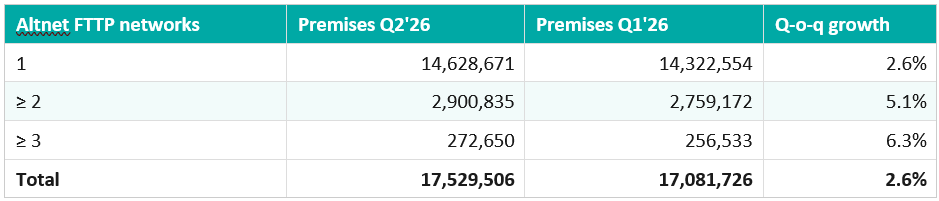
Overbuild among altnet FTTP networks grew again across the board: premises reachable by two or more altnet FTTP networks rose 5.1% quarter-on-quarter, and premises with three or more rose 6.3%. Total altnet FTTP premises increased by 2.6%.
Access the full dataset
The complete dataset used to produce this analysis is part of our UK Broadband Mapping product, available at postcode level.
Also, check out our broadband ontology, which features the structured map of operators, networks and the relationships between them. It is now available to any AI assistant that speaks the Model Context Protocol, with no account and no API key: https://mcp.point-topic.com/
Key September telecoms sector news
BT Group News
9 September – Ofcom set out the next stage of its copper retirement framework for Openreach. From 1 April 2029, Openreach will be able to change wholesale copper and part-copper prices at premises where its full fibre is available, in exchange areas where ultrafast (>300Mbps) coverage reaches 90% of premises, down from the previous 100% threshold. Where full fibre is not available, the existing copper price cap stays, and a charge control will apply to full fibre wherever the copper cap is lifted.
15 September – Openreach reported that two AI tools, "Crystal Ball" (which predicts the work and timescale needed when a complex FTTP install hits a snag) and "Ask Me Anything" (a generative AI customer Q&A capability), are now helping to prevent more than 3,000 full fibre order cancellations every month.
16 September – BT confirmed that more than 95% of its consumer customers have now moved to digital landlines ahead of the PSTN closure in January 2027. Following a trial that temporarily paused broadband (but not landline) service for customers who had ignored repeated contact, prompting over 80% of them to engage, BT is extending the approach to all remaining non-responsive customers. The same day, BT Business announced that its Drone SIM, running over EE's network, is enabling British Transport Police to become the first UK force to routinely operate national Beyond Visual Line of Sight drones.
17 September – Openreach named Liverpool as the leading major UK city in the move to digital phone services, with only around 6% of legacy lines left to migrate.
24 September – Openreach confirmed new safeguards for the final PSTN closure on 31 January 2027, which remains unchanged. Lines not migrated by the deadline may be moved to EVAc, a temporary last-resort emergency voice service priced at £35 a month (WLR3 Basic) or £38.60 (WLR Premium), and where technically possible Openreach will keep linked broadband services running. Openreach estimates around 1.2 million lines, including around 350,000 business premises, are still on the analogue network, with around 15 million migrated since 2017. James Lilley, Managed Customer Migrations Director, said: "No one should wait for the PSTN to close before upgrading."
28 September – In its first-ever block of an Openreach commercial offer, Ofcom directed Openreach to withdraw its "Incremental New to Openreach" FTTP discount (a £35 connection rebate plus up to £9.50 a month for up to 30 months on new-to-network customers above an ISP's baseline), confirming its July provisional view. In its final statement, Ofcom found the charges "not fair and reasonable and could harm the development of network competition," as they target exactly the customers altnets need to reach scale. Openreach's other notified offers, including the Geographic Incremental offer in Virgin Media O2's footprint and the Equinox extension, were allowed to proceed. Openreach said the decision was in line with the consultation and that it would review it carefully.
Throughout September – Openreach's full fibre build continued towards its 25 million premises target for December 2026, with thinkbroadband's tracking passing 23.5 million Ready for Service premises (around 70% of UK premises) on 4 September.
Virgin Media O2 (VMO2) News
9 September – VMO2 announced it is transferring management of its legacy Virgin Media email service to specialist provider Junara (owned by Atmail). Customers who wish to keep their addresses will receive the first 12 months free (18 months for those needing extra support), subject to a 99p transfer fee, with at least 45 days to decide from their first notification.
10 September – Speaking at Connected Britain, VMO2 CEO Lutz Schüler argued that blocking nexfibre's proposed £2bn acquisition of Netomnia would further damage UK fibre investment, warning that "no new investors [are] coming into this country and investing in fiber." He also suggested the future of the nexfibre build was in question given VMO2's financial pressures. The following day, VMO2's shareholders were reported to be targeting around £600 million in cost reductions. The CMA's Phase 2 statutory deadline for the nexfibre/Netomnia merger inquiry remains 15 December 2026.
15 September – O2 switched on its 5G+ (5G Standalone) network across Newcastle, wider Tyneside and Sunderland, reaching up to 890,000 people as part of its UK-wide Mobile Transformation Plan.
17 September – O2 activated five outdoor small cells in Tonbridge to boost local mobile capacity. The same day, VMO2 was reported to have made structural changes to its leadership team, with Consumer CEO Lyssa McGowan taking on oversight of marketing across the business.
24 September – VMO2 launched an AI voice agent to handle selected broadband fault calls, with human agents remaining available to all customers.
28 September – Responding to Ofcom's block of Openreach's NTO discount, nexfibre described the decision as "a positive step towards protecting competition," but said the regulator should have gone further, adding that it strengthened the case for approving its Netomnia acquisition.
CityFibre (CF) News
3 September – Following CityFibre's re-scoping of its Project Gigabit contracts in May, Norfolk County Council confirmed that CityFibre will now complete only drawdowns 1 and 2 (around 32,000 premises) of its original six-drawdown contract. Premises removed from drawdowns 3 to 6 will be considered under a new cross-regional (Type C) procurement, with a contract expected late 2026 or early 2027, a pattern expected to be mirrored in other affected counties.
24 September – BDUK's September contract data showed CityFibre's Hampshire built premises falling by 1,390 (to 5,720) due to a missing data submission dating back to December 2024, rather than a reduction in delivery. Its other contracts ranged from 19% to 82% complete.
28 September – CityFibre welcomed Ofcom's decision to block Openreach's new-to-network offer, calling on the regulator to continue monitoring Openreach closely and to prioritise sustainable infrastructure competition.
29 September – VodafoneThree confirmed that customer trials of its forthcoming 8Gbps Pro 4 broadband tier are running on CityFibre's network (with uploads of up to 6.5Gbps), alongside successful 10Gbps testing with CityFibre (see Other News below).
Altnets News
17 September – Zen Internet CEO Richard Tang published the seventh edition of his "Full Fibre Wacky Races" review of the UK altnet market, highlighting continued uncertainty over consolidation, funding and the market's eventual shape.
19 September – FullFibre Ltd (which merged with Zzoomm in 2025 and covers around 600,000 premises) was reported to have placed around 50 staff on notice of possible redundancy, with plans to outsource customer services offshore.
22 September – Macquarie-backed Voneus confirmed proposed organisational changes, including redundancies, as it integrates Airband, whose assets and customers it acquired out of administration for £4.6 million at the end of August.
25 September – Independent ISP Aquiss called for changes to One Touch Switching, saying 2–4% of its outbound migrations arrive with no OTS match, and urging that the Switch ID travel with the order onto the underlying network so it can be validated.
Late September – Small South Gloucestershire altnet RunFibre, together with its previous owner Fibre Nova, was revealed to have been acquired in August by the newly formed Bentry Infrastructure Group, its third change of ownership in around two years.
Other News
12 September – Marking two years of One Touch Switching, Ofcom reported that around 3.4 million people had started an OTS switch as of 3 September, with more than 300 providers signed up. It estimated out-of-contract triple-play customers could save over £100 a year by switching, noted that 4% of telecoms customers missed a payment last quarter, and launched a new Consumer Hub.
15 September – Amazon Leo added six more Ariane 6 launches (24 in total) to its Arianespace agreement, with a full commercial launch of its LEO satellite broadband service, including in the UK, expected around the end of 2026.
18 September – VodafoneThree began going live with its new Ericsson dual-mode, cloud-native 5G Core, designed for 9Tbps of capacity, marking the next phase of its post-merger network integration under its £11bn investment plan.
18–25 September – TalkTalk's break-up moved into its final stages. On 18 September Opus Broadband was reported to have stepped back from a c.£250m bid for TalkTalk Consumer, with lender Ares Management potentially taking long-term ownership, while TalkTalk and Octopus Investments said they remained optimistic on a PXC deal.
On 25 September, after reports of a revised c.£100m Opus offer, TalkTalk Group issued a strategic update confirming it is in advanced discussions to dispose of both its PXC and TalkTalk Consumer businesses, expected to conclude imminently. Later reports suggested private equity firm Epiris had entered detailed talks for PXC after Octopus's exclusivity ended. Companies House records also show that TalkTalk ceased to hold its c.51% controlling stake in Telecom Acquisitions Ltd (Home Telecom, Fleur Telecom, Eclipse Broadband and others) on 8 September, making TAL a fully separate company.
22 September – BDUK's Project Gigabit progress update reported gigabit-capable coverage above 88% of UK premises (around 4 million still without), 1.4 million premises reached through the programme by March 2026, and over £2bn committed through signed contracts, with awards under the cross-regional framework due to complete by the end of 2027. On the devolved nations, gigabit coverage stands at 95% in Northern Ireland, 83% in Wales and 82% in Scotland. Fibrus's Project Gigabit contract will reach a further 9,000 premises in Northern Ireland (over 2,400 already covered); GoFibre and Openreach contracts in Scotland have reached more than 5,600 premises; and around 60,000 premises in Wales are expected to benefit from Openreach contracts (over 7,000 reached so far). In Scotland, GoFibre also updated on its £105m North East Scotland contract (c.63,000 premises), with build underway in areas including St Fergus, Kincardine O'Neil, Newburgh and Kingswells.
23 September – The Government was reported to be considering a Social Market Foundation proposal to replace the £180 TV licence with an £11-a-month "Home Internet Levy" added to broadband bills as part of the BBC Charter Review. DCMS said it is looking at a range of options and no decision has been taken.
24 September – BDUK's September update on Project Gigabit contract progress showed around 318,000 of 846,770 contracted premises built (38%), up from 296,770 (35%) in August. The same day, Ofcom opened investigations into whether two telecoms companies failed to prevent misuse of their phone numbers by scammers.
25 September – Sky launched Full Fibre 1.6Gbps, its fastest tier on the Openreach network (covering 79% of UK homes), from £38 a month with its Wi-Fi 7 Gigafast+ hub, initially for new broadband customers. Also on 25 September, Ofcom published research showing 8% of online adults now use AI to help manage their phone, broadband or pay-TV services, and warned that AI must not become a barrier to reaching human support.
29 September – VodafoneThree announced Pro 4 Broadband, launching later this year with 8Gbps speeds and a new tri-band Wi-Fi 7 Ultra Hub 7+, alongside a new 5G Broadband Essentials social tariff. Separately, the Government increased the value of Openreach's Project Gigabit cross-regional (Type C) framework to £2.346bn.
Please get in touch if you would like to find out more about UK datasets, Point Topic's Broadband Dashboards, Knowledge Graphs, Broadband Mapping or particular publications.


Comments