
UK Broadband Q1 2026 Snapshot

Updated: May 28
The Quarter That Counts:
What BT’s Year-End Means for the UK Broadband Market
Point Topic tracks every UK network operator and ISP — 106 Altnet suppliers alone — every quarter. A snapshot of our Q1 2026 data is here, along with some key takeaways.
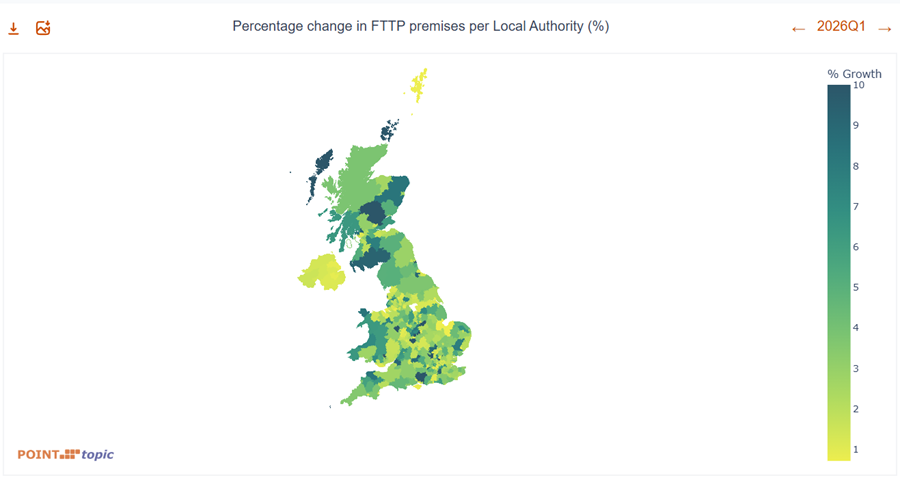
82.9% UK full fibre coverage up from 80.5% in Q4 | 13.19m FTTP connections +6.2% quarter-on-quarter | 3.76m Altnet FTTP base +32.6% year-on-year | 22.9m Openreach footprint premises passed with FTTP |
Q1 2026 confirmed that BT Group ended the quarter (FY26) in a materially stronger position than many investors had expected. Openreach delivered record FTTP build and connection growth, Consumer returned to sustained broadband growth, and FTTP now represents the majority of BT’s consumer broadband base. Yet despite the fibre acceleration, the wider UK broadband market remains structurally saturated, with competitive pressure increasingly shifting from network rollout to customer retention and take-up.
Openreach: building fast, converting steadily
Openreach passed 1.5 million additional premises with full fibre in Q1, averaging 125,000 per week, to reach a footprint of 22.9 million — including 6.3 million rural locations. Its FTTP connections grew by 553,000 in the quarter to reach 8.77 million, with a take-up rate now sitting at 38.3 per cent and rising.
Openreach’s total broadband line losses were 203,000 in Q1 — an improvement on Q4’s 210,000 but still significant. The company previously guided for around 850,000 full-year losses by end-March 2026, however, came in at 825,000. The Q1 data confirms that the guidance held, and brought some relief from TalkTalk customer displacement, One-Touch Switching dynamics, and Altnet competition.
BT’s Consumer division maintained positive growth with 26,000 net adds in Q1, reaching a total base of 8.22 million. Its FTTP subscriber base reached 4.16 million — 51 per cent of its total base — representing 30 per cent growth year-on-year. The strategic question going forward will test: is BT’s new multi-million pound ‘Behing Brilliant Things’ marketing campaign launched in early May, marketing its Plusnet brand aggressively enough to capture churning TalkTalk customers before Altnets do?
Three things to watch in the Q1 data
1 TalkTalk’s accelerating unwind
TalkTalk’s estimated subscriber losses eased to around 30,000 in Q1, a significant improvement from the 120,000 lost in Q4 — its weakest quarter of 2025. But the moderation in losses should not be mistaken for stabilisation. The business remains under considerable structural pressure following the January 2026 announcement that multiple divisions were being explored for sale, a process that intensified customer uncertainty during the quarter. The key market question is no longer whether TalkTalk continues to shrink, but where its remaining customer base is migrating. BT’s Plusnet brand, Vodafone and a growing number of Altnet-backed ISPs all appear positioned to benefit from the redistribution of TalkTalk’s estimated 2.56 million subscribers over the coming year, making its decline one of the most important drivers of UK broadband market-share movements through 2026.
2 VMO2’s FTTP take-up problem
VMO2’s full fibre take-up rate was estimated at just 8 per cent at the end of Q1 across a footprint that expanded to 7.8 million premises, still materially behind Openreach’s take-up rate of more than 38 per cent and highlighting a widening gap between network scale and customer conversion. While VMO2 continues to extend its fibre footprint, the operator reported a loss of 5,300 broadband lines during the quarter, underlining the continued pressure on its legacy HFC base from Altnet overbuild, One-Touch Switching and increasingly aggressive fibre pricing.
In contrast, Netomnia added an estimated 50,000 broadband customers in Q1, reinforcing the growing momentum of larger Altnets as they shift from build-led expansion towards subscriber acquisition and penetration growth. Although the proposed Netomnia-nexfibre transaction remains under CMA review and is not yet reflected operationally, the contrasting performance of the two operators is likely to shape how investors and competitors interpret the UK fibre market over the next 12 months.
3 Altnet consolidation and the take-up ceiling
Altnets added 188,000 FTTP subscribers in Q1, bringing their collective base to 3.78 million — up 33 per cent year-on-year. Average take-up across the Altnets we track reached 23 per cent. But the range is wide: Community Fibre at 32 per cent, Toob at 36 per cent, against Netomnia at 17 per cent and Trooli at 8 per cent. Q1 showed that slower build programmes are translating into slightly higher penetration rates, the model that financially sustainable Altnets need to prove, the market remains structurally saturated and highly competitive.

The pricing floor
One data series that Q1 crystallised: entry-level ultrafast pricing averaged £29.00 per month in March 2026, up just 3.96 per cent from Q4. The market’s self-imposed price discipline waned through the quarter as Q1 is the quarter in which annual price rises take effect — and our pricing data reinforces that consumer switching accelerated in response, albeit BT’s churn rates remained around 1.1%, indicating that it is pitching its pricing right for its different market demographics.
However, BT’s legacy superfast package was £30.99 per month in Q1 — the most expensive entry-level product in the market by a distance. Sky has dropped its entry-level superfast package from £46.00 in Q4 to £24.00 in Q1. Despite the intensifying pressure on consumers still on copper to migrate, Sky is clearly trying to gain subscribers at any cost. Sky added 18,000 connections in Q1, up from a modest 7,000 in Q4. Sky is clearly trying to capture some of the losses from TalkTalk, however, Q2 is usually a static quarter with the customer migrations easing after the annual price hikes and students ending contracts over the summer months.
How Point Topic produces these numbers Our quarterly metrics draw on company reports, operator announcements, regulatory filings and proprietary estimation where disclosures are incomplete. We track 106 Altnet network suppliers and ISPs alongside the five major retail ISPs — every quarter, without exception. Underlying all of this is the Point Topic Common Telecoms Ontology (CTO): a structured knowledge graph of UK operators, networks, services, and regulatory obligations, queryable via SPARQL at ontology.point-topic.com. The CTO is what allows us to produce estimates at operator level, not just market level — and to cross-reference competitive footprint, regulatory exposure, and take-up data in a single coherent framework. It is the foundation on which our Q-by-Q tracking is built. |
Q1 2026 data: available to subscribers
Q1 2026 captures the end of BT’s financial year, the first full quarter of Netomnia-nexfibre announcement effects, and the first price-rise cycle for consumers since Q4 2025. It is the most significant quarter of data Point Topic will have published in the current broadband cycle.
Our full Q1 2026 UK ISP and Network Operator metrics — covering retail subscriber movements, FTTP take-up rates, pricing, infrastructure footprints, and Altnet-by-Altnet analysis is now available. Subscribers receive the full dataset, operator-level tables, and interactive data access on publication day.
Access the full dataset
Full Q1 2026 metrics, operator-level data tables, and SPARQL access to the Point Topic knowledge graph are available to subscribers. Contact research@point-topic.com or visit www.point-topic.com to subscribe or request a trial.
About this analysis
This free analysis piece is based on Point Topic Q1 2026 estimates and company reports published to March 2026. It is provided for informational purposes. Q1 2026 figures are forward-looking context, not published data. © Point Topic Ltd 2026. Free to reproduce with attribution.

Comments